
About Us
The Rhode Island State Climate Office (RISCO) is the primary resource for climate services in Rhode Island. RISCO is housed in the Department of Environmental Management (DEM) and supported by the Office of Air Resources. We are recognized by the National Centers for Environmental Information (NCEI) and are a charter member of the American Association of State Climatologists (AASC). In cooperation with NCEI and the Northeast Regional Climate Center, we analyze and interpret climate data to aid decisionmakers and stakeholders. Our areas of expertise include past and present climate trends, drought monitoring, climate change impacts, and more.
Our Mission
- Provide pertinent climate data and information services to State agencies and the public
- Partner with the National Weather Service and the Rhode Island Water Resources Board to monitor drought
- Advance the state's knowledge of climate change in alignment with the Act on Climate
History
In 1954, the U.S. Weather Bureau (predecessor to the National Weather Service), established a climatologist in each state where “… there is maximum opportunity for collaboration with state officials, state universities, agricultural experiment stations, etc.”. Paul Kangieser, stationed at the U.S. Weather Bureau office in Boston, MA, originally covered all six New England states. In 1955, the responsibilities of Connecticut and Rhode Island were assigned to Dr. Albert Boyd Pack, who was based at the U.S. Weather Bureau office in Windsor Locks, CT. In 1960, Joseph Brumbach assumed responsibility of Connecticut and Rhode Island and served as State Climatologist for both states until funding ended in 1973.
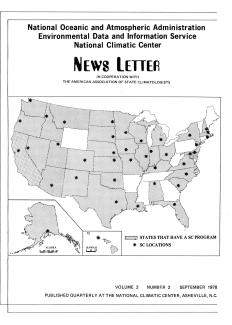
After the creation of the National Oceanic and Atmospheric Administration (NOAA) in 1973, Dr. Robert White - formerly chief of the U.S. Weather Bureau - sent a letter to each governor asking that they establish their own state climate program. By 1978, the position of State Climatologist, as supported by the State of Rhode Island, was re-established at the University of Rhode Island (URI) in the Department of Geography & Marine Affairs. Dr. James Havens served as State Climatologist until 1980.
In 1983, the State Climatologist program migrated to the URI Department of Plant Sciences. Dr. Robert Wakefield served as State Climatologist and conducted agronomy experiments at the Rhode Island Agricultural Experiment Station. He also oversaw the URI cooperative program weather station, the state's longest running climate site. Dr. Wakefield studied the impact of climate on agriculture and was president of the Rhode Island Association of Conservation Districts. Upon his retirement in 1989, Carl Sawyer, a research associate in URI’s Department of Plant Sciences, assumed the role of State Climatologist until 2000.
The Resilient Rhode Island Act was signed into law in 2014, which required the state to adaptively plan for and manage the impact of climate change. The position of State Climatologist was transitioned from URI to the DEM Office of Emergency Response to support the implementation of this new law. The transition from academia to a state agency was a pivotal moment, as the program's mission shifted from climate-agricultural research to operational climate services. Lenny Giuliano served as State Climatologist for over 10 years and formally established RISCO.
The Resilient Rhode Island Act was succeeded by the 2021 Act on Climate, which requires the Rhode Island Executive Climate Change Coordinating Council (EC4) to “Advance the state’s understanding of the effects on climate change…”. To aid the EC4, the State Climatologist program was transitioned to the DEM Office of Air Resources in 2025.
Contact Us
- Joseph Poccia, State Climatologist
- Phone: 401-537-4385
- Email: joseph.a.poccia@dem.ri.gov
- Darren Austin, State Meteorologist
- Phone: 401-537-4404
- Email: darren.austin@dem.ri.gov
- Chelsea Priest, Environmental Policy Analyst
- Phone: 401-537-4390
- Email: chelsea.priest@dem.ri.gov