
Tree Care & Maintenance
Trees on private properties, on streets, and on other publicly owned properties provide a multitude of aesthetic and environmental benefits to citizens, businesses and visitors alike. Beyond shade and beauty, trees also have practical benefits and a real monetary value that cities are sometimes unaware of — valuable public services with quantifiable economic benefits. And, unlike other gray infrastructure components, properly planted and maintained trees increase in economic and environmental value over time.
Regardless of who owns or is managing the trees, proper tree care is essential for healthy, structurally sound, and long-lived trees.
Maximizing the survival and contribution and value of your trees includes these steps:
- Selecting the right trees for the location
- Proper planting
- Mulch and water
- Prune correctly
- Monitor health and condition
For more details on best maintenance practices check out these helpful resources:
- Arbor Day Tree Care & Maintenance
- Trees Are Good Tree Owner Resources
- Tree Owners Manual Tree Owners Manual
- Morton Arboretum Tree Planting Best Practices and Guidelines webinar series
Selecting the best species for your site:
Lists of trees for specific situations abound. They are often a good starting point, but other factors must be considered to narrow down the list to truly suitable species for your chosen site.
- shade, moisture, overhead and underground utilities
- downtown vs residential, businesses vs greenway
- difficult sites and situations: wet areas, dry areas, ice storm resistance, salt tolerance
What is most important is to plant the right tree for the growing space, to limit future conflict or having to remove the tree before gaining all the environmental and economic benefits.
- RI tree suggestions for urban streets and for narrow spaces
- RI Climate and Health list
- Cornell recommended urban trees
- MA DCR
- Urban Tree Selection Guide
Tree Selector Tools
There are also numerous tree selector tools developed by different states and non-profit groups. These tools are interactive programs designed to match specific tree species to planting sites based on compatible characteristics.
Whether a community or an individual - you should strive to purchase the best tree for your site - that includes the form of the tree. In short, pick a tree that is branched like a ladder, not like a pompom.
This summary of what makes a quality tree is valuable information, whether for a municipality with a tree planting project or for a homeowner in a garden center: Nursery Specifications - with the full specifications here.
These specifications should be included in any municipal purchasing contract to ensure the trees are in good condition, can be refused if they do not meet the contract specs, and the delivered tree form can be pruned appropriately for the site. These specifications meet the American Standard for Nursery Stock which should be referenced on any purchase contract.
Soil Volume and Tree Roots
Tree Species Selection and Siting
Not all trees are the same in their response to pruning:
- Trees are not shrubs and should not be sheared.
- Training pruning for young trees video Young trees should be pruned to establish good growth patterns that will benefit the tree and future maintenance needs. IMPORTANT!!
- Evergreens Conifers have a different growing habit than deciduous trees
- Fruit tree basics Fruit trees have different goals than typical tree pruning, including accessibility to fruit and getting light into the interior of the tree
- Iowa State videos good visuals on how to prune
- What not to do video of common pruning issues that you should avoid
- Do not lions tail prune
While most trees can be pruned any time of the year, there are some considerations to avoid damaging the tree and getting the impact desired. Understanding how tree species grow and how they respond to pruning is useful information.
IMPORTANT CONSIDERATIONS FOR SUCCESSFUL TREE CARE & MAINTENANCE
Tree care is not simply planting and watering trees - it includes:
- relying on professional arborist to carry out work and use best management practices for tree care,
- understanding correct pruning and planting practices so the work done does not damage the trees,
- planning ahead to ensure trees are protected to maximize their longevity and environmental and economic contributions, and
- monitoring tree condition and health.
Tree care and management can be improved when an arborist is involved. Arborists are tree care professionals: knowledgeable about tree installation, care, preservation and management. Arborist in RI must be licensed to work in RI.
Why Hire an Arborist
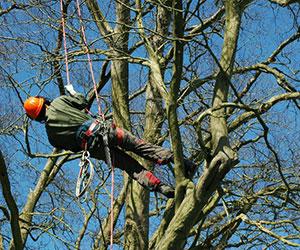
While it can be tempting for some owners to do some, or all, of their own tree work, or to hire a tree worker based solely on the cost quote, there are good reasons for only hiring certified arborists who carry the personal accreditation and commitment to the arboriculture profession. Pruning or removing trees, especially large trees, can be dangerous work. Tree work should be done only by those trained and equipped to work safely in trees.
- An arborist specializes in the care of individual trees.
- Arborists are knowledgeable about the needs of trees and are trained and equipped to provide proper care. Proper tree care is an investment that can lead to substantial returns. Properly maintained trees are attractive and can add considerable value to your property while poorly maintained trees can be a significant liability.
- An arborist does not top trees and should not do it, even if requested. A professional arborist knows the alternatives to topping that will keep your tree healthy so it can be enjoyed for many years.
- An arborist will only use climbing spikes in trees that are being removed, to avoid damaging the tree's protective bark that may allow insects and disease to enter.
Protect Yourself
- Never pay in advance. Don't be rushed by "do-it-today" bargains.
- Beware of door knockers. Most reputable companies have plenty of work without going door to door. Be particularly wary of door knockers after storms as some non-professionals can end up creating risk situations and doing more damage to a storm damaged tree.
- Ask for references. Look at previous work and talk to previous clients.
- Ask for certificates of insurance, including proof of liability for personal and property damage, and workman's compensation. Call the insurance company and ask if the policy is current. In some circumstances, you can be held financially responsible if damage is done to a neighbor's property or an uninsured worker is hurt on your property.
- Ask to see the RI Arborist License for the individual doing the work. You can confirm or check their license here.
- Shop around. Have more than one arborist look at your job and give you an estimate.
Resources
Avoid the temptation to "top" a tree. Topping is a harmful tree pruning practice and does not make a tree more "safe". Despite more than 25 years of literature and seminars explaining its harmful effects, topping remains a common practice.
What is tree topping?
Tree topping is exactly what it sounds like: removing the top of the tree. This reduces the tree’s remaining top branches to little more than stubs. As a result, the tree is left with a bare, unnatural appearance, and undergoes stress as the tree puts out new branches and leaves in order to survive.
The main reasons trees are topped:
- Reduce interference with electrical wires.
- Shorten trees thought to be growing too tall
- Concern that a tall tree is more likely to fall in a storm
While topping may seem a reasonable action to address these concerns, tree topping is NOT the way to do it. In the long-run, topping a tree can prove to be a costly mistake. The trees health and structural stability will be affected, reducing the value and longevity of the tree, as well as increasing the risk of branch failure.
Alternatives to tree topping
- The best way to manage tree growth and maintain tree health is to consult a Certified Arborist. These tree care professionals know how to correctly and safely prune trees, and they can explain how to best maintain and care for them.
- Reduction pruning is an effective alternative to topping. Carefully placed cuts reduce branch length, minimize wound size and reduce sprouting.
- Correct pruning when a tree is young can help reduce some of the structural issues that develop as a tree matures. “Training pruning” combines carefully placed cuts with an understanding of how a tree grows.
- LOOK UP! Plant future trees in a suitable growing space for their mature size. Make sure you’re not planting where the tree height or crown spread could conflict with structures or utilities. If you are, find a new spot.
RESOURCES
- Why Topping Hurts Trees
- What’s Wrong with Topping Trees
- DFAE mini-poster: Why Topping Hurts Trees
COMMON MYTHS ABOUT TREE TOPPING
-
Topping reduces storm damage by reducing the tree height and branch length.
WRONG – Topped trees respond to the loss of foliage by pushing out new branches and leaves, often regaining and even exceeding their original height. However, these weakly attached branches (and the decay which can occur at the cut) are more likely to break in a storm. Therefore, a topped tree increases the risk for storm damage and the related clean-up costs.
-
Topping works for trees the same way it works for shrubs, revitalizing the tree.
WRONG – The flush of new growth is not invigorating; it is actually a survival response that exhausts the tree’s energy reserves. Topping is a physical injury that damages and stresses a tree, makes it more susceptible to pests and disease, and opens it up to internal decay. The loss of leaves starves the tree, since both the crown and the roots suffer, further damaging the tree. A tree can survive topping, but its life will be shorter.
-
Topping increases property value.
WRONG – Topped trees have lost their natural form and beauty. In addition, the increased risk of failure from decay and weakly attached branches increase maintenance costs as well as potential liability.
-
Topping is so common that it must be the right thing to do.
WRONG – Just because a poor practice is observed repeatedly does not mean it is appropriate tree care. Research has proven, and practice has confirmed, that topped trees are ugly, more costly and pose greater risks than properly pruned trees. No reputable professional tree care company would ever advise or admit to tree topping.
Homes are often constructed near existing trees to take advantage of their aesthetic and environmental value. Unfortunately, the processes involved with construction can be deadly to nearby trees.
Work on existing home sites, like landscaping, driveway or sidewalk repairs, utility maintenance, etc. can also damage trees and tree roots.

What to know about tree roots
- A tree's roots develop and survive where there is adequate oxygen and moisture. Most active tree roots are in the top 3 feet of soil, with the majority in the top 6-18 inches. And the roots typically grow outward to about three times the branch spread.
- When roots are cut, or extra soil is placed over them, or constant vehicle traffic compacts the soil over them, or chemicals, oil or gas are spilled near them, the roots are damaged and the tree becomes stressed as it tries to adapt to the changes.
- Outward symptoms of this stress may not become apparent for a few years (5-7 years is not uncommon post construction). Younger trees may be better able to adapt to changes than older trees, and some species will adapt more successfully than others.
- If protection measures are not taken around a valuable tree it may succumb to construction activity induced stress and become more of a liability than the valuable asset expected.
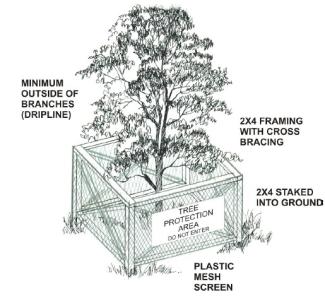
Tree Protection Zones (TPZ)
The TPZ is an area around the tree where construction and equipment use is prohibited. At a minimum it should be encompass a radius of at least 1.25 feet for each inch of trunk diameter. For example, a tree with an eight-inch diameter trunk (diameter measured at 4.5 feet above the ground) should have protection all around in at least a ten-foot radius from the trunk. There is no conversion of inches to feet involved here, just a simple multiplication of the number.
- Good – 1.25 x 8 (inches trunk diameter) = 10 foot radius TPZ
- Better – 1.5 x 8 (inches trunk diameter) = 12 foot radius TPZ
- Best – 2.5 x 8 (inches trunk diameter) = 20 foot radius TPZ
RESOURCES

Mature large trees add significance to our landscapes but they require care and monitoring to maintain in a healthy and structurally sound state. And as they age, the cost of maintenance and the potential for breakage or failure can increase. Maintaining elderly trees requires additional planning and budget, to spend funds on trees with the best return of time and stability.
WHY MANAGE VETERAN TREES?
These veterans are a link to our past, a part of the local landscape and history. In our urban society, most veteran trees are no longer retained and managed. Some old trees may garner interest because of their existence during historical events, but most old trees are neglected at best, or removed for development, agriculture, risk reduction, or just because they are old and defective.
But these old trees still provide environmental benefits, as well as their historic presence. And managing those trees; developing strategies for their preservation; and avoiding unnecessary removal is important. An entire management strategy that addresses a tree's biology, life stage, and risk, for the purpose of a tree's preservation is called Conservation Arboriculture, based on the recognition that:
- Trees provide a wide range of benefits to society
- Trees are living organisms which naturally lose branches or fall
- The risk to human safety from trees is very low
- Tree owners have a duty of care for their trees
- Approach to tree management must be balanced and proportionate.
RESOURCES
Local training and volunteer opportunities for home owners
Local resources for information and training for home owners
Community volunteer groups