Regenerative Agriculture
Funding Opportunity
Administered by DEM’s Division of Agriculture, the 2027 Local Agriculture and Seafood Act (LASA) Grant Program, includes funding for regenerative agriculture projects. Awards up to $20,000 will be available for projects that help Rhode Island farmers adopt and expand practices that reduce greenhouse gas emissions, increase carbon sequestration, improve soil health, reduce nutrient runoff, strengthen farm resilience, and enhance the long-term sustainability of our state’s agricultural sector.
LASA Grant ProgramRegenerative Agriculture is a conservation management approach that emphasizes natural resources through improved soil health, water management, and natural vitality for the productivity and prosperity of American agriculture and communities.
Key Practices
- Crop rotation
- Cover cropping
- No till/reduced till
- Rotational grazing
- Integrated pest management
- Drainage water management
- Forage harvest management
- Forest stand improvement
- Irrigation water management
- Mulching
- Nutrient management
Natural Resource Conservation Service (NRCS) Contacts
The NRCS Regenerative Pilot program offers funding to help establish new and support established regenerative agriculture methods on owned and leased farmland. To find out more about these funding opportunities, contact the district offices below.
Northern RI | NRCS Field Office Serving Providence County
- Kate Bousquet, District Conservationist kate.bousquet@usda.gov 401-822-8814
- Northern RI Conservation District mallard.nricd@gmail.com 401-934-0840
Eastern RI | NRCS Field Office Serving Bristol and Newport counties
- Ghyllian Alger, District Conservationist ghyllian.alger@usda.gov 401-822-8835
- Eastern RI Conservation District info@easternriconservation.org 401-934-0842
Southern RI | NRCS Field Office Serving Kent and Washington counties
- Jameson Long, District Conservationist jameson.long@usda.gov 401-822-8837
- Southern RI Conservation District sricd.info@gmail.com 401-500-0422
Examples of Regenerative Agriculture Practices in Rhode Island
Farming for the Future: Regenerative Practices at Barton Farm
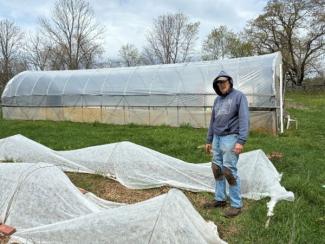
West Bay Community Action farmer Steve Stycos has been farming Barton Farm in Warwick for the past 17 years. West Bay Community Action is a charitable organization dedicated to helping Kent County residents with food assistance, utilities, health, safety, and education services. For more than 20 years, West Bay has leased over four acres of land from the City of Warwick, where they now grow more than 20,000 pounds of fresh vegetables each year.
Steve has long embraced regenerative farming practices such as crop rotation, integrated pest management, and nutrient management. While “regenerative agriculture” may be a popular term today, these time-tested methods have been used successfully for generations. In his greenhouse, Steve rotates crops by growing tomatoes for two years, followed by cucumbers for one year. This approach improves soil health, reduces weeds, and minimizes pests and diseases naturally.
He also uses integrated pest management techniques to eliminate the need for pesticides. One effective method is covering crops with floating row covers—lightweight, breathable fabric that shields plants from pests, frost, and wind while still allowing sunlight and water through. Once flowers begin to bloom, the covers are removed so pollinators can do their important work.
To keep his soil healthy and productive, Steve regularly tests it through the University of Connecticut and carefully applies only needed nutrients. He uses organic fertilizers on all of his crops.
Over the years, Steve has received valuable support from the Natural Resources Conservation Service, which helped fund two greenhouses and fencing around his largest field. He also received a Warwick Rotary International grant for new farm equipment and a Community Development Block Grant to support construction of a barn.
The West Bay Farmers Market takes place each summer on Thursdays from 4:00 PM to 5:30 PM at Barton Farm. It is a wonderful opportunity for the community to enjoy fresh, locally grown produce while supporting an important local mission.
After 17 years of dedicated service, Steve will be retiring soon. This spring, he will train his successor in the many successful farming practices he has developed over the years, including regenerative agriculture. In retirement, we are sure he will find other ways to serve his community.
Growing Regeneratively: Martinez Farm Expands into Chicken Farming

For nearly a decade, Teo has drawn on his agricultural experience in the Dominican Republic and continued learning in Rhode Island to pursue his passion for growing fresh produce for the Southside community. His father taught him to farm as a child, and today he runs Martinez Farm.
Martinez Farm was awarded $7,410 in funding to expand into regenerative chicken farming. The farm will purchase two mobile chicken tractors—portable, enclosed structures that can be moved regularly across a field. This will allow chickens to safely access fresh grass and insects while preventing overgrazing in any one area. By moving the chicken tractors to new areas every few days, the chickens will naturally till the soil, add nutrient-rich manure, and help control pests. Previously grazed areas can then recover and regrow before the chickens return, supporting healthier soil and pasture.
This is not Martinez Farm’s first use of regenerative agriculture. The farm already practices cover cropping, planting specialized vegetation to protect and improve soil between cash crops. The farm will integrate laying hens into these fields, where the chickens can forage for insects and vegetation while helping recycle nutrients and improve soil health. Rotating the birds across leased acreage will also allow the farm to make better use of existing land, diversify income through egg production, and reduce purchased feed costs.
Over the long term, the project will support climate-smart agriculture by reducing purchased inputs, improving soil health, and making better use of existing acreage. For Martinez Farm, these practices can also strengthen the farm’s long-term viability by diversifying income, improving land quality, and supporting more productive use of leased fields.
The project also supports the goals of Rhode Island’s 2025 Climate Action Strategy, which identifies regenerative agriculture as an approach for building agricultural resilience, improving soil health, and reducing greenhouse gas emissions. Through rotational grazing and regenerative land management, Martinez Farm is putting these practices into action while investing in the future of its farm and community.
Ensuring Food Safety from Field to Storage Growing Hope Farm

Growing Hope Farm was awarded close to $20,000 in funding to develop a year-round wash-and-pack station that allows it to scale safely and efficiently. This infrastructure will serve as the backbone of the post-harvest workflow and bring them into compliance with the food safety expectations of buyers, markets, and regulators. Furthermore, it will also be able to complete RI Grown registration and take part in more farmers' markets, including those managed by Farm Fresh RI and the Rhody Fresh Market series
While the wash-and-pack station is a post-harvest infrastructure investment, it supports the long-term viability of Growing Hope Farm's regenerative farming system. Regenerative agriculture is an approach to farming that focuses on improving soil health, increasing biodiversity, enhancing water retention, and strengthening ecosystem resilience while producing food. By improving operational efficiency and expanding market access, the new facility helps ensure the economic sustainability of these land stewardship practices, allowing the farm to continue investing in healthy soils, diverse crop production, and environmentally responsible farming methods.
With these upgrades in place, there is a projected 212% increase in CSA capacity for the next season, the addition of one new market outlet, and a 513% increase in total farm sales. These operational improvements will translate to stronger margins and better labor efficiency across the board. LASA support allows the farm to grow responsibly, meet compliance standards, and deliver more fresh, safe food to Rhode Island families.
Strengthening Rhode Island’s Native Plant Supply Chain

Dragonfly Nurseries, LLC, is a women-owned Rhode Island nursery specializing in regionally sourced, ecotypic native plants, or plants that have specifically adapted to the unique environmental conditions of a specific region or habitat. One of the only nurseries in Rhode Island dedicated to preserving local genetic diversity through partnerships with regional seed collectors and propagators, Dragonfly Nurseries provides essential native perennials, grasses, shrubs, and trees that support pollinators, wildlife, and climate resilience across Rhode Island and the region. Using ecotypic plants restores natural ecosystem functions, significantly reduces water and chemical inputs, and builds climate-resilient landscapes.
Dragonfly Nurseries has been awarded $19,877 in funding to expand its capacity to grow and supply ecotypic native plants by constructing a fully functional production greenhouse. Demand for locally adapted, genetically diverse native plants exceeds current capacity. The nursery has had to decline restoration and landscape projects because of the existing open-air outside; seasonal, temporary benches limit propagation and grow-out. This project directly addresses that constraint. The new greenhouse will provide year-round propagation and controlled growing conditions, improving survival rates, quality, seasonal availability, and the ability to propagate a diversity of ecotypic species. With appropriate ventilation, heating, and automated irrigation, Dragonfly will increase total output, broaden the range of ecotypic species available, and better align supply with the planting windows of Rhode Island partners, including landscape contractors, municipalities, conservation districts, land trusts, Tribal Nations, and environmental firms.
Beyond expanding production, this project supports climate resilience and regenerative land management goals. Ecotypic native plants typically establish deeper root systems and are better adapted to local environmental stressors than non-local or ornamental species, making them more resilient to drought, extreme weather, pests, and changing climate conditions. Their extensive root networks help improve soil structure, reduce erosion, increase water infiltration, and support soil microbial communities, all of which contribute to healthier and more resilient ecosystems.
Native plant communities can also enhance long-term carbon sequestration by storing carbon in both plant biomass and soils, particularly when used in habitat restoration, pollinator plantings, and conservation landscapes. By increasing the availability of ecotypic native plants for restoration and land stewardship projects, Dragonfly Nurseries will help strengthen Rhode Island's capacity to implement nature-based climate solutions that support biodiversity, improve ecosystem function, and contribute to long-term climate adaptation and mitigation efforts.
Regenerative Agricultural Practices
Below are NRCS videos showing regenerative program practices. View more information and resources at https://www.nrcs.usda.gov/programs-initiatives/regenerative-pilot-program