Green Infrastructure & Resiliency Activity in RI
Rhode Island has a lot happening with urban forestry - not just in the UCF program, but also in other state divisions and many local groups.
These efforts work with residents and communities, providing assistance, support, planning, planting, and other valuable resources. Whether large-scale infrastructure efforts or one-on-one community support efforts, there is a broad commitment across RI to improve our landscape function and the benefits provided by green infrastructure.
Scroll down to learn more about who is working in RI and what they are accomplishing:
Carbon sequestration in Rhode Island
RIDEM is partnering to develop more accurate estimates of carbon storage in RI. With over 50% of the state being covered in forest, forest carbon, both above and below ground, is a significant component in mitigating greenhouse gas emissions. RIDEM has partnered with The Nature Conservancy and the University of Maryland to use the most up-to-date methods to estimate carbon stores in RI. This is an exciting opportunity to apply recently developed tools to increase our understanding of the value of RI's forests.
Urban & Community Forestry

The Division of Forest Environment's Urban & Community Forestry Program uses mainly federal funds to provide assistance to communities and non-profits in RI, as well as educational institutions. This is achieved through:
- awarding small subgrants for local projects to develop or improve the management of their urban forest
- applying for larger federal awards to deliver more significant assistance
- providing large subgrants to develop capacity: such as special training for RI arborists, or supporting partners who deliver specialized products
- providing larger tree-planting subgrants, funded by the RI Regional Greenhouse Gas Initiative (RGGI), allows for greater impact in low tree cover locations. Some funding has also been awarded through the Executive Climate Change Coordinating Council (EC4) to support improved urban tree survival in RI.
Some of the types of projects and outcomes are listed below:
The partnership of UCF and Green Infrastructure Center predates the federal assistance from IRA and congressionally directed funding received in 2022/23. Multiple communities in RI have been assisted to develop their management and planning capacity for their urban forests: identifying priorities, assessing ordinances strengths and weaknesses, as well as assisting with planting projects that help meet local goals. Urban tree inventories, strategic planting plans, maps and canopy assessments are some of the outcomes of these projects.
Check out some of the reports here.
- East Providence
- Bristol
- Barrington
- Warren
- Newport
- Central Falls
- Pawtucket
- Westerly
- Woonsocket
- North Providence
- Cranston
RCDL is a partnership between UCF and URI's Department of Landscape Architecture and Planning. This project is an on-going effort using summer students to assist small communities with conceptual designs to help develop functional greenspaces. Not only does this help RI's small communities, but it also provides real hands-on experience for local students. We are entering the 3rd year of this project and are looking for other funding mechanisms to help support this program and see it grow.
The project opens for applications each January-March and is described here.
You can see more about RCDL and the completed projects here.
Communities assisted so far:
2024
- West Warwick
- South Kingstown
2025
- Charlestown
- Providence
- Cumberland
2026
- Richmond
- North Providence
- Scituate
The UCF program provides subgrants for education, planning and small, targeted tree planting projects through the federally Urban and Community Forestry Grant Program. There is also a state funded subgrant program funded by RGGI for larger planting projects that target low tree cover areas within communities through the Tree Equity RI Grant Program.
Department of Health
DOH has been a partner with the UCF program starting with a heat map project in 2020 - identifying urban heat islands, which are associated with a lack of green infrastructure that ultimately impacts health outcomes. Green infrastructure is a well-researched aspect of human health, from asthma emergency department visits to health recovery timelines. (See this recent study.)
These issues are a component of the DOH Health Equity Zones (HEZ) initiative, an internationally recognized, community-centered model for improving health outcomes, reducing costs, and strengthening the systems that shape community well-being. Over the past decade, HEZs have established a statewide infrastructure that aligns residents, community organizations, healthcare systems, and public agencies to deliver community-led, data-informed solutions across housing, education, food access, workforce development, and other areas that shape people’s lives, which are known as the Social Determinants (or Drivers) of Health (SDOH).
The HEZ network includes 14 local collaboratives that engage more than 1,300 partners and reach 72% of Rhode Islanders. Each HEZ collaborative represents a region, municipality, or neighborhood where partners work together to meet the unique needs and priorities of the people living there and connect local priorities to broader public health objectives.
Recent efforts addressing the green infrastructure components of community health and resilience through HEZs:
With support from the USDA Forest Service’s Urban and Community Forestry Program, through the Inflation Reduction Act (IRA), 7 HEZs are delivering measurable environmental and economic benefits to communities across the state through local urban forestry initiatives.
Since early 2025, these investments have resulted in more than 300 new trees planted, hundreds of additional trees maintained or distributed to residents, and more than 120 tree-related hazards addressed, improving neighborhood safety and resilience. The initiative has also created workforce development opportunities for more than 60 youth and adult participants, building local capacity for long-term environmental stewardship.
Collectively, these efforts are projected to prevent nearly 500,000 gallons of stormwater runoff and remove approximately 950 pounds of air pollutants, demonstrating how targeted community investments can generate tangible public health, climate, and infrastructure benefits statewide. These early outcomes are laying the foundation for continued community-driven investment, expanded environmental resilience efforts, and sustained impact in the years ahead.
Through a $135,000 investment from the Rhode Island Executive Climate Change Coordinating Council (EC4) and the Department of Environmental Management (DEM), HEZs are advancing community-led climate resilience efforts that strengthen local preparedness, environmental health, and cross-sector collaboration across Rhode Island. This initiative supports 3 HEZs in convening residents, municipal leaders, and stakeholders to identify specific climate and environmental priorities within each HEZ. Through this work, the pilot aligns local efforts with statewide goals and develops actionable, community-driven strategies for building resilience.
The 3 HEZs are also participating in a statewide community of practice (CoP) addressing the health effects of climate change and environmental SDOH. This collaborative model of shared learning, data-informed planning, and sustained stakeholder engagement continues to generate community-informed recommendations for future climate investments, policy development, and implementation strategies. It ensures that future funding decisions are responsive to local needs and positioned for long-term impact.
Regional Resilience Coordinators
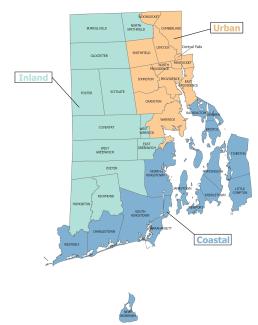
Local capacity building and technical assistance at the municipal level is a sustained need, as evidenced by RIIB's Municipal Resilience Program (MRP) process. In response, RIDEM hired three Regional Resilience Coordinators (RRC) in 2025, who are housed in RIDEM’s Narragansett Bay National Estuarine Research Reserve, in partnership with the Audubon Society of Rhode Island. The Regional Resilience Coordinators offer municipalities science-informed technical and policy assistance for projects that improve community and ecological resilience across Rhode Island
Each RRC works with different regions of the state (Coastal, Urban, and Inland) to help fill in the gaps in municipal capacity with technical assistance for resilience projects. Coordinators hold Annual Resilience Update Meetings with cities and towns that guide services the coordinators will provide and the projects to which they will contribute.
As of 2025, all municipalities completed the MRP workshop which helped communities to understand ongoing community and climate change issues. This process allowed municipalities to identify areas where they could be more resilient to climate change and natural hazards – and develop their list of priority actions to address these challenges.
In that short period of time, RRCs have assisted 17 municipalities with grant applications, and have assisted with 20 individual grant proposals
Regional Resilience Coordinator regions and contact information can be found on the state’s Climate Resilience webpage.
- Grant writing and proposal development
- Background research and case studies
- Communication on funding and assistance opportunities
- Community engagement and outreach
- Municipal resilience planning and project identification
- Project management
- Data analysis and mapping
Brownfield Remediation
RIDEM Office of Land Revitalization & Sustainable Materials Management
Rhode Island's rich industrial history has left a legacy of properties that once fueled economic growth, but today may be underutilized or impacted by environmental concerns. Site Remediation & Targeted Brownfield Assessment Program assists RI communities by providing environmental assessments and planning support to address local brownfields. This program supports the redevelopment and reuse of contaminated sites through the Brownfields program. Sites are identified, evaluated, remediated, and brought back to beneficial reuse in Rhode Island communities.
Site Planning, Assessment, and Remediation Collaborative (SPARC) applies for EPA funding to support the assessment and revitalization of these properties, helping restore their functionality, reduce environmental risk, and position sites for productive reuse. By turning dormant or challenged properties into community assets, SPARC supports sustainable redevelopment while preserving the value and potential of Rhode Island's built landscape.
Their ArcGIS StoryMap explores projects and success stories, highlighting community impacts from bringing these sites back to functional landscapes with all the benefits that green infrastructure provides: RIDEM's Brownfield Program

- Rhode Island Infrastructure Bank (RIIB): Brownfields Revolving Loan Fund
- Brownfield Remediation Solar Incentive
- EPA brownfields history in RI
- Woonsocket
- Providence
- Job Training for Dads in Rhode Island
RI Infrastructure Bank

RIIB provides funding to RI communities to address infrastructure through several mechanisms, including Climate Resilience and Brownfield Remediation.
It also offers training to municipalities through the Municipal Resilience Program. This allows them to be eligible to apply for RRIB grants to the Municipal Infrastructure Grant Program (MIGP) to improve public infrastructure. Some of these projects address green infrastructure.
Check out these TNC videos about various projects in RI for Community-led Climate Action.
RI non-profits active in urban forestry
There are multiple groups in RI that are focused on green infrastructure, several also engage in public education or in work skills training to support residents and increase knowledge and expertise. Education is an important part of the implementation projects that local partners deliver across RI.
Most of these groups also have opportunities for volunteer engagement. Check out their information:
Providence Neighborhood Planting Program
Woonasquatucket River Watershed Council