
Trees as Green Infrastructure
Infrastructure is often thought of as the roads, power lines, water systems, schools or hospitals that support and improve human settlement. This is known as gray infrastructure. For gray infrastructure to function, there has to be connectivity. The highways need to be connected to side streets, and utilities needs to be connected to residential areas so people have access to electricity and water. Roads provide access to services and emergency response; water and water treatment facilities manage the demands of local populations.

Green infrastructure is applying these same concepts of connectivity to trees and the natural system. Much of the discussion about green infrastructure revolves around stormwater management: green and built solutions/processes to reduce flows to sewer systems or surface water through interception, storage, infiltration, or evaporation. But green infrastructure can be applied more broadly, to include multiple needs in our communities and benefiting all residents and can actually be a holistic or strategic approach that addresses the economic and social impacts of sprawl and fragmented land, taking into account the many benefits and services provided by green space, waterways, parks, forests and fields.
Green infrastructure not only supports the physical processes and systems around us, but it also sustains us. Mental well-being, physical health, recovery, exercise, social interaction, community identity, volunteerism, and engagement – living in green infrastructure brings us out into our communities.
Trees in both rural and urban areas are an important part of green infrastructure. Individual trees, and small or large green spaces, as well as natural areas, sustain clean air and water, reduce soil erosion, provide wildlife habitat, and numerous other benefits. Trees provide clean air and water, provide shade which cools parking lots and buildings, mitigate storm water run-off effects, and increase real estate values.
"Green infrastructure is the interconnected natural systems and ecological processes that provide clean water, air quality and wildlife habitat. Green infrastructure sustains a community’s social, economic, and environmental health." - Green Infrastructure Center
More about Green Infrastructure:
Why is Green Infrastructure Important?
Green space or open space is often thought of as isolated parks or recreational areas and is viewed as self-sustaining, or something "nice to have", or as vacant land simply not yet developed. But to function effectively, green infrastructure must be managed. More importantly, planned and managed green infrastructure systems mitigate the need for expensive grey infrastructure installations.
Managing green infrastructure effectively recognizes that development and growth are inevitable and necessary, but the pattern of that growth, its location, form, and intensity can be directed and managed to reduce negative impacts. Developing long range strategies to incorporate natural areas and green spaces into land use planning, especially in the planning early stages, would maximize the impact and effectiveness of all infrastructure for economic, environmental, and social benefits.
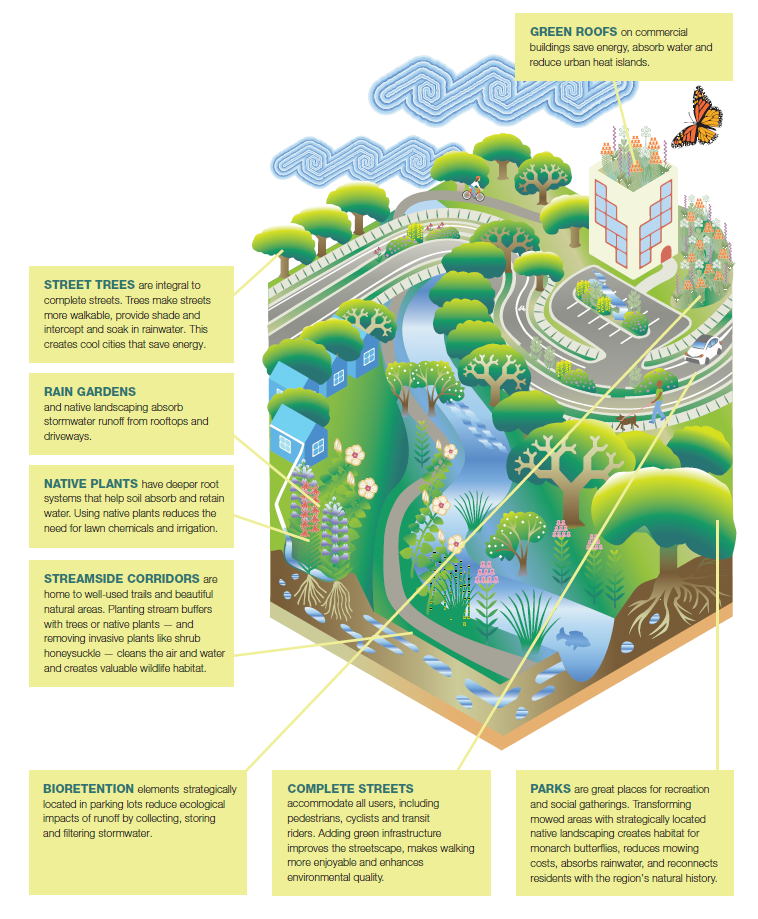
WHAT DOES GREEN INFRASTRUCTURE LOOK LIKE?
Management of the green infrastructure takes planning. But it can be managed at different levels or scales for a variety of objectives, which allows it to be flexible and adjustable to the needs of current development.
Green infrastructure systems can be:
- Protected watersheds that decrease the need for man-made water treatment facilities.
- Reforested slopes that help control flooding events and landslides.
- Protected waterways that prevent soil erosion, improve water quality, and provide wildlife habitat corridors.
- Planted swales or detention ponds that absorb and filter storm water run-off.
- Semi-porous paving stones that decrease direct storm water run-off from parking lots.
- Private forest land that protects water quality, provides wildlife habitat, and increases ecosystem biodiversity.
- Parks and greenways connecting through neighborhoods, improves air quality and habitat.
- Canopy cover in and around housing developments, decrease stormwater runoff and improve water quality entering local water bodies.
- Street trees, healthy and undamaged, provide shade and reduce the heat island effect.
GREEN INFRASTRUCTURE & WATER
Forests
Urban Forests & Stormwater
PLANNING FOR GREEN INFRASTRUCTURE
- Quick Guide to Community Planning for Green Infrastructure: A quick look at the planning processes for community-based planning with local priorities:
- Planning Tools for Small Communities: Several ways to help communities assess the value of green infrastructure and promote its inclusion in the planning process:
- Banking on Green: A Look at How Green Infrastructure Can Save Municipalities Money and Provide Economic Benefits Community-wide
- Natural Areas Conservancy: Focuses on natural areas in cities and the Forests in Cities network
- Green Infrastructure Center: Provides green infrastructure assistance and resources to communities.
- Rhode Island Tree Equity Funding, Financing, and Policy Guide
