Rhode Island Marine Species Profiles
Information on Rhode Island marine species managed by the Division of Marine Fisheries is presented below in alphabetical order (by common name), grouped by the following sections:
- Fish
- Invertebrates (including crustaceans and shellfish)
- Seaweed
- Marine Mammals
- Reptiles
This is not an exhaustive list of species that may be encountered in Rhode Island marine waters! You can also check out the RI State Wildlife Action Plan and database for details on other species in Rhode Island. Information provided here is up to date as of July 2026.
Fish
For more detailed information and a more complete list of fish in Rhode Island waters, check out our new book: Marine Fishes of Rhode Island.

Identification:
Atlantic mackerel (Scomber scombrus) are iridescent blue green on the back with a silvery white underbelly with their distinct coloring fading quickly after dying. These fish have 20 to 30 wavy black bars that run across the top half of their spindle-shaped body, and a narrow dark streak that runs below these bars along each side. They have two large dorsal fins that are grey with pectoral fins that are black or dusky at the base. Atlantic mackerel grow fast, up to 16 ½ inches and 2.2 pounds.
Habitat:
Atlantic mackerel are common in cold and temperate waters over the continental shelf. They swim in schools near the surface, and travel to and from spawning and summering grounds. They are found on both sides of the North Atlantic Ocean, including in the Baltic Sea. In the western Atlantic, they are found from Labrador to North Carolina.
Species Info:
Atlantic mackerel are small schooling fish that feed heavily on crustaceans such as copepods, krill, and shrimp. They can live up to 20 years and are able to reproduce by the time they reach age 2 to 3. Depending on size, females can have between 285,000 and almost 2 million eggs, releasing their eggs in batches between five and seven times through spawning season. Atlantic mackerel are preyed upon by several species of fish and marine mammals.
Regulations & Management:
Atlantic mackerel are one of the most important Atlantic coast fisheries, due to its importance ecologically and in the commercial industry. NOAA Fisheries and the Mid-Atlantic Fishery Management Council manage the Atlantic mackerel fishery under the Atlantic Mackerel, Squid, and Butterfish Fishery Management Plan. Mackerel are managed in federal waters; there are no state management measures for mackerel. Mackerel are managed using annual catch limits allocated between the commercial and recreational fisheries. Managers monitor commercial catch on a weekly basis and will close the fisheries if the limits are reached before the season is over. All fishermen must have a permit to harvest Atlantic mackerel. The total amount of permits is limited to control harvests.
See our latest Annual Fisheries Report to see recent harvests. It is also worth nothing that other species of mackerel (e.g., chub and Spanish) do occur in Rhode Island waters.
Sources:

Identification: Atlantic Menhaden (Brevoortia tyrannus) are a schooling fish that grows to about 15 inches in length. These fish have a large, forked tail (caudal) fin. The main feature used to identify menhaden is the dark spot that can be found just behind the gill plate. Towards the head, menhaden have a toothless mouth which is used for feeding on plankton.
Habitat: Atlantic menhaden prefer to live in coastal waters or estuaries all along the Atlantic coast of the US. Menhaden are a schooling fish and can often be found in large schools near the water’s surface.
Species Info: Atlantic Menhaden, sometimes called “Pogie” or “Bunker” are a small, schooling fish that feeds on plankton in the water column. Atlantic Menhaden are an ecologically important species in local waters because of their place in the food chain. Menhaden are preyed upon by many species, including Striped Bass, Bluefish, and other predatory fish.
Regulations & Management: The fishery for Atlantic Menhaden is one of the most important Atlantic coast fisheries, due to the importance of this species commercially, and ecologically. For these reasons, the Atlantic States Marine Fisheries Commission manages Menhaden under the Interstate fishery management plan. This plan Divides a total catch limit (quota) between Atlantic coast states. This ensures that Menhaden harvest is kept at healthy levels for the entire coast.
Rhode Island Minimum Size & Possession limits can be found here: Marine Fisheries Minimum Sizes & Possession Limits | Rhode Island Department of Environmental Management
Sources:

Identification: Black Sea Bass (Centropristis striata) are typically a black or dusky brown color, with slightly lighter colors on their belly. During spawning, the dominant males turn bright blue with a blue hump on their heads. They have long dorsal fins, which often exhibit white spots and bands. The forward portion of the dorsal fin is spiny, with the rear being soft. Their tail (caudal) fin often features a tendril which extends from the top of the fin. Black sea bass have large mouths with small teeth
Habitat & Species Info: Black Sea Bass can be found along the U.S. East Coast. They are a temperate reef species, and therefore prefer habitats with structure, such as reefs, oyster beds, rock outcroppings, or even wrecks. They migrate offshore in the winter months and come back inshore during the spring as the water temperatures start increasing. Black Sea Bass females can live for up to 8 years, while males can live up to 12 years. These fish are protogynous hermaphrodites, meaning that most are born female, and can then transition into a male as they grow and mature. This process usually happens at sizes around 9-13 inches. When fully grown, these fish can reach sizes up to 24 inches in length. Their diets consist of crabs, worms, shrimp, clams, and small fish.
Management & Regulations: Management of the black sea bass fishery is conducted cooperatively by the Atlantic States Marine Fisheries Commission, Mid-Atlantic Fishery Management Council, and NOAA Fisheries. The Summer Flounder, Scup, and Black Sea Bass Fishery Management Plan is the tool used to manage these species. This management plan uses catch and landings limits to maintain the health of the fishery.
Rhode Island Minimum Size & Possession limits can be found here: Marine Fisheries Minimum Sizes & Possession Limits | Rhode Island Department of Environmental Management
Buy locally caught black sea bass! According to NOAA, black sea bass is a “smart seafood choice” thanks to sustainable management and responsible harvest. Here’s where to find what’s being caught by fishermen, and where buy locally caught black sea bass:
- RI Seafood Finder | Rhode Island Seafood Marketing Collaborative
- Weekly Landing Data | Rhode Island Seafood Marketing Collaborative
Sources:

Identification:
The blue shark (Prionace glauca) is a pelagic shark named for their distinct blue color that fades to a white underbelly. This contrast in colors is known as countershading and provides camouflage for the shark in the open ocean. They have a long, sleek body and an elongated conical snout. Blue sharks also have very long, pointed pectoral fins with the dorsal fin being closer to the pelvic fins than pectoral fins. The caudal fin is heterocercal meaning the upper portions is larger than the lower lobe of the fin. Teeth of the blue shark are highly distinctive in shape, triangular with highly curved cusps, strong serrated edges and bases that overlap each other.
Habitat:
Blue sharks can be found in temperate and tropical oceans from latitudes of 60 degrees north and 50 degrees south. They are a pelagic species that rarely come near shore but have been known to frequent inshore areas around oceanic islands and locations where the continental shelf is narrow. Being a pelagic species, the blue shark’s habitat consists of open ocean areas from the surface to 350 meters in depth. They prefer cooler water ranging from 12–20 °C. When in the tropics, the blue shark seeks deeper waters with cooler temperatures. At night, the blue shark often swims inshore around oceanic islands.
Species Info:
The maximum size for the blue shark is about 380 cm. Males are believed to be mature at 4-6 years of age and at lengths between 6 and 7 feet. Females mature slightly older ages than males (5 – 7 years) and longer lengths (7 feet). The lifespan of blue sharks is believed to be more than 20 years. Blue sharks often aggregate to feed on schools of prey. They prefer small bony fishes, such as herring and sardines, and invertebrates, such as squid, cuttlefish and pelagic octopi. They feed actively at night but are known to feed throughout the entire day. Gestation periods of the blue shark range from 9 to 12 months with the average litter holding about 30 individuals, with up to 80 pups in a litter. Young are born in summer or spring. Predators of the blue shark include killer whales and larger sharks including the shortfin mako and the white shark.
Regulations & Management:
The blue shark is the most heavily fished shark in the world with annual global catch estimates of around 20 million individuals each year. The species is rarely targeted commercially but bycatch by longline and driftnet fisheries is very high. Blue shark catch is included in the regulated commercial longline shark fishery on the Atlantic and Gulf coasts of the United States (Managed under the Magnuson-Stevens Fishery Conservation and Management Act). The entire fishery is limited to landing 580 metric tons dry weight of pelagic shark species. The main conservation issue that needs to be addressed is minimizing mortality rates of blue sharks caught as bycatch. According to the International Union for Conservation of Nature (IUCN), the blue shark stock assessment shows stocks as largely depleted with the population trend decreasing.
In Rhode Island, there is currently no limit on the number of blue sharks that can be harvested commercially.
Rhode Island Minimum Size & Possession limits can be found here: Marine Fisheries Minimum Sizes & Possession Limits | Rhode Island Department of Environmental Management
Sources:
Identification:
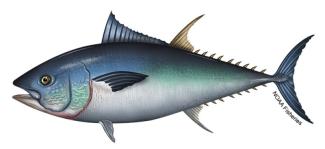
The Atlantic bluefin tuna (Thunnus thynnus) has a large, torpedo-shaped body with a dark blue-black on the back and white on the lower sides and belly. They have colorless lines alternating with rows of colorless spots on their lower sides. They have a reddish-brown dorsal fin with short pectoral fins. They are the largest tuna species and can reach up to 13 feet and 2000 pounds.
Habitat:
Atlantic bluefin tuna live near the surface in temperate waters but frequently dive to depths of 500 to 1000 meters. They are highly migratory species. In the western Atlantic, bluefin tuna are found from Newfoundland to the Gulf of America. They tend to spawn in the same areas in the Gulf of America.
Species Info:
Bluefin tuna grows more slowly than other tuna. They have a long lifespan, up to 20 years or more and generally do not spawn until they are around 8 years old. They spawn from mid-April to June, mainly in the Gulf of America. Females can produce up to 10 million eggs a year. Bluefin tuna are top predators with juveniles primarily feeding on fish, squid, and crustaceans. Adults feed mainly on baitfish such as herring, bluefish, and mackerel. Sharks, marine mammals, and large fish feed on bluefin tuna. Bluefish and seabirds are known to prey upon juvenile bluefin tuna.
Regulations & Management:
Overseen by NOAA, the Atlantic Highly Migratory Species Management Division manages the Atlantic bluefin tuna fishery in the United States and sets regulations for the U.S. based fishery. These decisions are informed by conservation and management recommendations from the International Commission for the Conservation of Atlantic Tunas (ICCAT), consistent with applicable U.S. laws. Effective conservation and management of highly migratory species like bluefin tuna require international cooperation as well as strong domestic management. Managed under the 2006 Consolidated Atlantic Highly Migratory Species Fishery Management Plan and Amendmentsthe following regulations exist:
- Fisherman must have a permit to harvest bluefin tuna
- Annual quote and sub quotas
- Gear restrictions
- Time/area closures
- Minimum size limits
- Federal management for Atlantic tunas applies to state waters as well. Connecticut and Mississippi are exempt, but NOAA Fisheries periodically reviews these states’ regulations to make sure they’re consistent with federal regulations.
Regulations do not allow bluefin tuna to be targeted in the Gulf of America, an important spawning area for the species. In 2000, the United States established the Dolphin-Safe Tuna Tracking and Verification Program to monitor the domestic production and importation of all frozen and processed tuna products nationwide, and to authenticate any associated dolphin-safe claim.
Rhode Island Minimum Size & Possession limits can be found here: Marine Fisheries Minimum Sizes & Possession Limits | Rhode Island Department of Environmental Management
Sources:

Identification: Bluefish (Pomatomus saltatrix), as their name implies, exhibit a blue-green color along their backs, transitioning to a silvery color on their belly. Bluefish have an athletic, streamlined profile, highlighted by their large, forked tail (caudal) fin. Another identifying feature of bluefish are their large eyes, which are often a distinct yellow color. Inside their large jaws, are a set of sharp, pointed teeth. Bluefish are a relatively large species, capable of reaching sizes upwards of 30 pounds, reaching lengths up to 40 inches.
Habitat & Species Info: Each year, Bluefish migrate north with warming waters in the spring, before retreating southward as waters cool down in the fall and winter. During the winter, Bluefish are generally found between North Carolina and Florida. The summer is when Bluefish return to Rhode Island, with their range shifting from Maine to North Carolina during warmer months. Bluefish are known to travel in massive schools, sometimes covering square miles of ocean. As their appearance suggests, Bluefish are well adapted to being predators, feeding on a wide variety of species of baitfish and squid. Spawning behavior of bluefish follows a similar pattern to other species, with the fish spawning during the spring and summer months of the year. Spawning happens offshore, with juvenile fish moving to more protected areas to grow.
Rhode Island Regulations & Management: The Bluefish fishery is managed cooperatively by the Atlantic States Marine Fisheries Commission, the Mid Atlantic fishery management council, and NOAA fisheries. Specifically, the Bluefish Fishery Management Plan governs management of Bluefish. Under this management plan, yearly catch limits are set, preventing the overfishing of this fishery.
Rhode Island Minimum Size & Possession limits can be found here: Marine Fisheries Minimum Sizes & Possession Limits | Rhode Island Department of Environmental Management
Sources:

Identification:
Atlantic bonito (Sarda sarda), also know was the “true bonito” and “northern bonito” is torpedo shaped with 5-11 diagonal black stripes extending from the dorsal region toward the belly. It has a dark blue color on its back and upper sides, lacking any dark stripes on its belly. The species can also be identified by their relatively short pectoral fins and a deeply forked tail fin.
Habitat:
Atlantic bonito inhabit coastal and pelagic waters. In the Western Atlantic, populations extend from Nova Scotia, Canada, southward to northern Argentina, with notable concentrations along the eastern United States coastline. These migratory fish prefer temperatures between 50° - 80° F, though they show optimal activity in 60 °- 70° F. Seasonal migrations follow predictable patterns, with fish moving northward during spring and summer, then retreating to warmer southern waters as temperatures drop.
Species Info:
During warmer months, Atlantic bonito move into shallower coastal areas for feeding and spawning. They typically occupy the upper 200 feet of the water column, rarely venturing into deep oceanic zones. Atlantic bonito are predators that consume a diverse array of prey species, adapting their diet based on seasonal availability and local abundance. Primarily, they prey on small schooling fish such as mackerel, menhaden, sardines, anchovies, and sand lance. Smaller bonito will primarily feed on small baitfish while larger bonito will expand their diet to include shrimp, squid, and other crustaceans. Atlantic bonito are known to cooperatively hunt in large schools. As ram ventilators, Atlantic bonito must continuously swim to force water over their gills, this constant motion combined with their high metabolism, requires frequent feeding.
Regulations & Management:
The International Commission for the Conservation of Atlantic Tunas (ICCAT) oversees management in international waters, though specific regulations for bonito remain limited compared to larger tuna species. Most management of Atlantic bonito occurs at national and regional levels. Rhode Island DEM (RIDEM) is actively working on new regulations for Atlantic bonito. Currently, these species have no management regulations in Rhode Island. Despite no current regulations, anglers are encouraged to support a precautionary framework which includes a 16-inch minimum size limit and a commercial landing cap.
In 2025, RI Division of Marine Fisheries (RIDMF) began a pilot project to collect data on Atlantic bonito. As a part of this project, RIDMF began testing a cheap and effective way to measure these fish accurately using images. The project is a citizen science project and is one of the largest ever instituted by RIDEM. Volunteers are given a plastic card with instructions on how to photograph the fish properly. Images are then sent to RIDEM for analysis using the software ImageJ to measure the fish based on the size of the given card in the image.
- For more information on the project, and the other species targeted, please see the link.
Sources:
Identification:
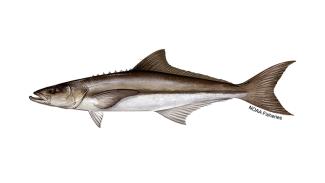
Cobia (Rachycentron canadum) are dark brown in color with lighter colored undersides and a single dorsal fin. They are often mistaken for shark or remora because of their similar shape and coloration. In adolescence, cobia have a distinct coloring that fades with maturity. Young cobias have black and white horizontal striping with splotches of bronze, orange, and green. Cobia average in sizes between 3 and 4 feet in length, reaching up to 6 feet.
Habitat:
In U.S waters cobia are most abundant from southern Virginia to the Gulf of America. They seasonally migrate in the Atlantic moving south and offshore toward warmer waters during the late fall and winter, and in the northeastern Gulf of America, moving south to the Florida Keys area for the winter. In these waters they are often found in structured habitats like shipwrecks, artificial reefs, and debris, and found in areas that large animals like sharks, turtles, and stingrays also inhabit.
Species Info:
Cobia are strong aggressive predators that travel alone or in small groups. They mainly consume crustaceans, smaller fish, and squid. Young cobias are preyed on by larger pelagic fish, but adult cobia have few predators. Cobia spawn in coastal bays and estuaries several times during their spawning season which spans from late June to mid-August in the Southeast and from late summer to early fall in the Gulf of America. Cobias live up to 12 years and are able to reproduce young, females at age 3 and males at age 2. During spawning, females release between 375,000 and 2 million eggs each time.
Regulations & Management:
Recreational fishermen often target cobia, but commercial fishermen do not directly target the species. Commercially, cobia is often caught while trawling for shrimp or fishing for other species. Recreationally, fishermen target cobia because it is a large, powerful fish, making it an impressive catch. NOAA Fisheries and the Gulf Council manage the cobia fishery in the Gulf of America and on the east coast of Florida. The Atlantic States Marine Fisheries Commission manage the cobia fishery on the Georgia coast through New York. The two management plans are managed by the Fishery Management Plan for Coastal Migratory Pelagics, which enforces the following rules and regulations:
- Fishermen do not need a federal permit to harvest cobia
- Drift gillnets are prohibited
- Authorized gear includes automatic reel. Bandit gear, handline, rod and reel, and pelagic long line
- Cobia must be a minimum size and have heads and fins intact to be harvested
- Commercial and recreational fishermen have annual catch limits, size limits, trip limits, and per person per day or per vessel per day bag limits
Sources:

Identification:
Atlantic cod (Gadus morhua), are a heavy-bodied fish with a large head, blunt snout, and barbel under the lower jaw. Their color varies from light, yellowish green to a reddish olive, with a lighter underside. They typically have speckles on their head, fins, body, and tail. This species has a distinct but faint lateral line running lengthwise down each side.
Habitat:
Atlantic cod ranges from Greenland to Cape Hatteras, North Carolina. In U.S. waters, this fish is most common on Georges Bank and in the western Gulf of Maine. Atlantic cod prefers colder water and can often be found around 30 to 500 feet on the ocean floor consisting of rocky slopes and edges.
Species Info:
This species can weigh up to 77 pounds, grow up to 51 inches, and live for over 20 years. Females produce between 3 and 9 million eggs, and they spawn near the ocean floor from winter to early spring. Atlantic cod are considered top predators in the bottom ocean community, feeding on many types of fish and invertebrates. Historically, this species was quite abundant in New England waters, so early explorers named Cape Cod after the fish. Today, we see much fewer cod in the U.S. stocks due to high fishing pressures.
Regulations & Management:
Regulation and management of Atlantic cod in the U.S are divided into two stocks, the Gulf of Maine stock and the Georges Bank stock. NOAA fisheries and the New England Fishery Management Council manage Gulf of Maine cod and collaborate with Canada to manage Georges Bank cod because the stock spans the international boundary. In New England waters Atlantic cod, along with other groundfish are managed under the Northeast Multispecies Fishery Management Plan which enforces:
- Permit requirements for commercial vessels
- Separate management measures for recreational vessels
- Year-round and seasonal area closure to protect spawning fish and habitat
- Minimum fish sizes for harvest
- Annual catch limits
Due to both Atlantic cod stocks having high fishing pressures, there are rebuilding plans in place to target and restore population levels.
Rhode Island Minimum Size & Possession limits can be found here: Marine Fisheries Minimum Sizes & Possession Limits | Rhode Island Department of Environmental Management
Sources:

Identification:
The common thresher shark (Alopias vulpinus), also called the Atlantic thresher shark, is known for its iconic tail fin that is sickle-shaped, with the upper lobe of the caudal fin (top half of the tail) being about half the length of the shark’s body. Thresher sharks are brown, gray, blue-gray, or blackish on the back and underside of their snout. They are lighter on the sides, and fully white below. Their pectoral, pelvic, and dorsal fins are blackish, and there are sometimes white dots on the tips of the pectoral, pelvic, and tail fins.
Habitat:
These sharks are found in temperate waters around the world. In the northwest Atlantic Ocean, they range from Newfoundland to Cuba. Common thresher sharks are highly migratory species, often traveling entire ocean basins. They’re most common near land and often found in areas rich with plankton, where their prey is also abundant.
Species Info:
Common thresher sharks live on average 19 to 50 years, reproduce late in life, and have only a few young at a time. They grow slowly but can reach up to 20 feet long. Males sexually mature when they’re 8 to 11 feet long and up to 3 to 6 years old. Females are able to reproduce when they’re 8 to 11 feet long and 4 to 5 years of age. This species mates in late summer with females giving birth to live, fully developed young after a gestation period of 9 months, only having a few pups. Common thresher sharks are aggressive predators that feed near the top of the food chain, mainly on schooling fish such as herring and mackerel. They will occasionally feed on squid and seabirds. They are known to use their large tails to stun fish before preying on them. Adult thresher sharks have few predators, but younger smaller individuals may fall prey to larger sharks.
Regulations & Management:
NOAA Fisheries and the Atlantic Highly Migratory Species Division manage the Atlantic common thresher shark fishery in the United States. The fishery is managed under the Consolidated Atlantic Highly Migratory Species Fishery Management Plan. Highly migratory species, such as thresher sharks, have complicated management that requires international cooperation. To commercially harvest Atlantic sharks, vessel owners must obtain a valid Atlantic shark directed or incidental limited access permit or a smooth hound shark open access permit (Atlantic HMS fishery compliance guide). Atlantic common thresher sharks are primarily caught incidentally in longline fisheries targeting swordfish and tuna. Recreationally, thresher sharks are mainly caught with rod-and-reel gear. Recreationally fisherman must have an Atlantic HMS permit to harvest thresher sharks in federal waters. As of January1, 2018, all HMS permit holders will need a “shark endorsement” to fish for, retain, possess, or land sharks. Recreationally fisherman are required to use circle hooks, as they increase the survival of the sharks that are caught and released. Sharks must be a minimum size to be caught, and there is a limit on how many sharks can be caught per fishing trip.
U.S. wild-caught Atlantic common thresher shark is considered a smart seafood choice by NOAA Fisheries since it is sustainably managed and responsibly harvested under U.S. regulations. The International Commission for the Conservation of Atlantic Tunas conducted a ecological risk assessment for pelagic sharks caught in Atlantic pelagic longline fisheries and ranked thresher sharks as the least vulnerable to these fisheries and more productive than other species included in the assessment.
Rhode Island Minimum Size & Possession limits can be found here: Marine Fisheries Minimum Sizes & Possession Limits | Rhode Island Department of Environmental Management
Sources:

Identification:
Cunner (Tautogolabrus adspersus) range in color from red to a bluish brown gradient, becoming paler towards the underbelly. Cunner are often mistaken for tautog but can be distinguished by their thinner smaller lips, typically smaller body, and scales around their gills. They average in size 6 to 10 inches typically never surpassing 1 foot in length or over 3 pounds.
Habitat:
Cunner are found in coastal waters in the Atlantic coasts of North America and in offshore banks, ranging from the east coast of Newfoundland to the southern coast of New Jersey, occasionally being found as far as Chesapeake Bay. They inhabit shallow waters with rocky areas near structures like seawalls and wharves.
Species Info:
Cunner’s are omnivores, eating both small plants and animals. They feed primarily on invertebrates, which include, small lobster, mussels, shrimps and sea urchins. This species plays an important role in maintaining the homeostasis of food webs as it keeps crustacean populations in control, and is prey to larger fish, acting as an important food source.
Regulations & Management:
Cunner do not have a commercial or recreational market but are sometimes harvested recreational or caught as by-catch. The species in monitored in some New England state recreational fishery surveys, but there are no regulations such as size or bag limits in place.
Sources:

Identification:
Dusky sharks (Carcharhinus obscurus) are a wide ranging coastal and pelagic species that prefer temperate to tropical waters. They are large-bodied, typically grey with dusky margins on the fins. They possess a low interdorsal ridge.
Habitat:
Dusky sharks are highly migratory, ranging from shallow inshore waters to the outer continental shelf and adjacent oceanic waters. Adults tend to avoid areas of low salinity and rarely enter estuaries. It ranges from Nova Scotia to Cuba including the Gulf of America (Formerly Gulf of Mexico) and from Nicaragua to southern Brazil in the western Atlantic Ocean.
Species Info:
Dusky sharks make large scale seasonal migrations, often covering thousands of kilometers per migration event. In the western Atlantic, dusky sharks are known to move North during the summer and south in the winter. In South Africa and Australia, they are known to move north during the austral winter-spring and south during the austral summer-autumn. Dusky sharks are also known to segregate by both size and sex. Dusky sharks are an important fisheries resource, targeted and taken as bycatch around the world. Their fins are highly valued. Due to the dusky sharks slow growing, maturing late, and having small litters, they are particularly vulnerable to overexploitation.
Regulations & Management:
Dusky sharks are federally and state protected as a prohibited species. In federal waters, NOAA Fisheries handles the regulation of dusky sharks. At the state level, they are managed by state agencies like Rhode Island Department of Environmental Management (RIDEM) in the state of Rhode Island. Dusky sharks are legally classified as a highly migratory species and are managed under the Atlantic Highly Migratory Species Management Division of NOAA. The International Commission for the Conservation of Atlantic Tunas (ICCAT) also assists in dusky shark management since they cross international borders and are commonly caught as bycatch by global fishing fleets. Since dusky sharks are a prohibited species, they are protected under U.S. federal regulations making it illegal for both recreational anglers and commercial fisherman to retain, land, or possess them. If a dusky shark is accidental caught, it must be immediately released in the water with minimum harm to insure survival.
Sources:

Identification:
False albacore (Euthynnus alletteratus), commonly referred to as little tunny, get their name due to their similar appearance to tuna. They can be distinguished by a difference in coloration and shorter pectoral fins. They are torpedo shaped with metallic coloring fading from dark blue on the top to a silver underside. These fish have a patterned series of dark colored wavy lines on their upper side and 3 to 7 dark spots between the pectoral and pelvic fins. The species size varies across their wide geographic range with Mediterranean populations growing larger than Atlantic populations. These regional size variations are most likely due to environmental factors like water temperature, prey availability and fishing pressure. On average the species size ranges from 20-32 inches in length and 7-20 pounds.
Habitat:
False albacore inhabits the Atlantic Ocean in tropical and subtropical waters which include the Mediterranean, Black Sea, Gulf of Mexico, Caribbean Sea, Ascension Island, Gulf of Guinea and West Africa. They are most abundant in the Western Atlantic from New England to Brazil, in the Eastern Atlantic from Skagerrak to South Africa, and the Mediterranean Sea throughout the basin. They spend time in both open ocean and coastal environments, typically found in reef associated habitats nearshore and surface waters near the continental shelf offshore. The species are migratory, moving seasonally to warmer coastal waters for spawning and prey availability.
Species Info:
The species travels in fast moving large compact schools and are opportunistic predators who adapt to prey availability and environmental conditions. Their diet consists mainly of small schooling and larval fish, as well as crustaceans and squids. False albacore is also prey to larger predators like shark and swordfish.
Regulations & Management:
The false albacore population and fishery is monitored under the umbrella term ‘small tunas’, which includes other species like blackfin tuna and Atlantic bonito, by the International Commission for the Conservation of Atlantic Tunas (ICCAT). However, no specific commercial or recreational regulations exist due to the populations stability and low economic importance compared to other tuna species.
False albacore is also a targeted species in the 2025 pilot project along with Atlantic bonito. Volunteers are given a card with instructions on how to properly photograph the fish. Images are then sent to RIDEM for analysis using the software ImageJ to measure the fish based on the size of the given card in the image.
- For more information on the project, and the other species targeted, please see the link.
Sources:

Identification:
Lined seahorse (Hippocampus erectus) are small “S” shaped bony fish that can be pale yellow, orange, red, brown, and grey or black in color depending on environmental factors. The species can be characterized by its long snout and prehensile tail and can often be mistaken for a plant or seaweed. They can be distinguished by white lines that following the contour of its body and small white dots on the tail.
Habitat:
Lined seahorse populations range from the North Atlantic coasts of Cape Cod to shores of the Gulf of America and Venezuela, to the South Atlantic coasts down to Uruguay, migrating to southern climates in the winter season. They inhabit mangroves, seagrass, coral, and floating sargassum habitats often seen clinging to aquatic vegetation.
Species Info:
Lined seahorses are sexually dimorphic, with the presence of a brood pouch at the base of the abdomen of males. Courtship behaviors are complex with partners displaying changes in color becoming pale to whitish. The female transfers her eggs into the male's brood pouch where the eggs are fertilized. The brood pouch protects the developing embryos and provides them with oxygen. Hatched embryos are carried within the pouch until they can actively swim.
Regulations & Management:
While seahorses are not targeted in fisheries in the western Atlantic Ocean, they are targeted in other regions where they are commonly traded for ornamental display, aquarium fishes, and traditional Chinese medicine.
Any lined seahorses caught by anglers are generally not subject to any retention regulations. However, it is recommended that any live individuals are released unharmed because they are relatively uncommon, have low mobility, and depend on sensitive estuarine habitats. Therefore, they are classified as unregulated but are a conservation-sensitive estuarine species managed primarily through habitat protection, ecosystem monitoring, and international trade controls rather than species-specific harvest regulations.
Lined seahorses currently have no species-specific regulations put in place by Rhode Island Department of Environmental Management Division of Marine Fisheries (RIDEM DMF).
Sources:
Identification:
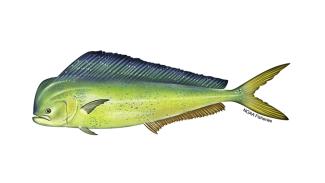
Atlantic Mahi-mahi (Coryphaena hippurus) are brightly colored with an electric greenish blue back, a lower body of gold/yellow with small silver-colored spots, and a mixture of dark and light spots on each side of the abdomen. These bright colors fade almost immediately after the species is harvested. Mahi-mahi range on average 3 to 7 feet in length, with size variation among individuals often depending on the sex. Adult males typically reach larger sizes and have a square head, while females tend to be smaller with a rounded head.
Habitat:
Atlantic mahi-mahi live near the ocean surface in tropical and subtropical waters in the Atlantic, Gulf of America, and Caribbean, being caught from Massachusetts to Texas. Larger males are typically found in open ocean habitats, while females, juveniles, and smaller males are typically found near natural or artificial floating objects like floating algae patches.
Species Info:
Mahi-mahi can live up to 5 years and reproduce at ages 4 to 5 months, during spawning season it is believed that they spawn every 2 to 3 days, often under patches of floating brown algae called Sargassum. In daytime, mahi-mahi are a top surface water predator, eating a wide variety of species. This includes small pelagic fish, juvenile tuna, invertebrates, and pelagic larvae of nearshore, bottom-living species. Predators of mahi-mahi include large tuna, marine mammals, marlin, sailfish, and swordfish.
Regulations & Management:
NOAA Fisheries, the Caribbean Council, and the South Atlantic Fisheries Management Council manage Atlantic mahi-mahi. In the U.S Caribbean, mahi-mahi are managed under the Puerto Rico Fishery Management Plan, the St. Croix Fishery Management Plan, and the St. Thomas and St. John fishery management plan which enforces annual catch limits in federal waters. In the U.S South Atlantic, mahi-mahi are managed under the Fishery Management Plan for the Dolphin and Wahoo Fishery of the Atlantic which enforces:
- Required permits to sell mahi-mahi
- Minimum size limit for species caught off the coasts of Georgia, Florida, and South Carolina
- Recreational bag limits
- Commercial trip limits
- Annual catch limits
Sources:

Identification:
Monkfish (Lophius americanus) also known as goosefish are often described as being tadpole shaped, with broad flat bodies, an upward facing wide mouth, and a narrow tapering body. All monkfish fins are thick and fleshy except its dorsal fin. Their body has no scales with speckled dark brown to olive-green skin on top and whitish skin underneath. Males and females are able to reproduce when they reach around 14 inches and 16 inches long respectively, while adult monkfish range between 2 and 4 feet in length.
Habitat:
Monkfish are found in the Northwest Atlantic Ocean, broadly distributed across the US continental shelf, ranging from Newfoundland to North Carolina, most often found in sand, mud, and shell ocean floor habitats. They can tolerate a wide range of temperatures and depths from inshore habitats to depths of nearly 3,000 feet. Adult monkfish spend most of their time on the sea floor in depressions or partially covered sediment. They also spend some time off the bottom most likely riding with currents during seasonal migrations to spawn and feed.
Species Info:
Adult monkfish are carnivorous and opportunistic feeders meaning they will eat almost anything that crosses their path, which includes small fish, shrimp, squid, other monkfish, crabs, lobsters, octopus, and even seabirds. Monkfish consume their prey using a modified spine on their head like a fishing pole and bait to lure small fish towards their mouths, where they then take a large gulp, sucking the prey into its mouth. Their predators include swordfish, sharks, and thorny skates, but the larger the monkfish the fewer predators it has.
Regulations & Management:
The monkfish fishery is jointly managed by the New England Fishery Management Council and Mid-Atlantic Fishery Management Council using a system which limits the number of days the fish can be harvested per year. Commercial fisheries for monkfish operate year-round using gillnets, trawls, and dredges. Monkfish fisheries have two management areas, the Northern Management Area (NMA) which occupies the Gulf of Maine and northern Georges Bank and the Southern Management Area (SMA) which occupies southern Georges Bank and Mid-Atlantic Bight. Typically, monkfish caught in the NMA are caught by vessels using bottom trawl gear, and monkfish caught in the SMA are caught by vessels using gillnets. Both the NMA and SMA are managed under the Monkfish Fishery Management Plan which includes annual catch limits, limited access permits, size limits, landing limits, and measures to reduce bycatch and impacts on habitat. In 2024, the commercial landings for monkfish totaled 13 million pounds and was values at $9 million, making monkfish one of the highest valued finfish in the Northeast.
See our latest Annual Fisheries Report for details about recent harvest.
Sources:

Identification:
Northern kingfish (Menticirrhus saxatilis) are flat bellied, slender with a long spine, and have a distinct barbel on the chin. On average they grow to be around 10 to 14 inches and weigh 1.5 pounds. They are scaled; the lower half of their body is silver and upper half of the body is silver to bronze. They are patterned with dark angular bands along the body which form “V” shapes and dark horizontal strips behind the pectoral fins which extend onto the lower half of the caudal fin. These characteristics distinguish them from Southern and Gulf Kingfish whose stripes are not as prominent.
Habitat:
Northern kingfish inhabit shallow coastal waters in schools near hard or sandy bottoms, commonly spotted in surf zones, beach shores, and estuaries from the Gulf of Maine to the Gulf of America. Most commonly found in southern regions the species is most abundant between Cape Hatteras, North Carolina, and Cape Cod, Massachusetts. Juveniles and adults make large seasonal migrations, moving south in Winter most commonly occurring off the coast of North Carolina in spring, and along the coast between North Carolina and Massachusetts in summer and fall.
Species Info:
Kingfish are bottom feeder and mostly consume shrimp, small mollusks, worms, crabs, and other small crustaceans and fish. Their predators include sharks, tuna, and bird species such as herons. The average life expectancy of a northern kingfish is 2 to 3 years with males reaching sexual maturity at age 2 and females at age 3. Spawning occurs during the months of April until August typically in bays, sounds, and outside estuaries.
Regulations & Management:
Northern kingfish are popular with recreational anglers and sometimes caught by gillnets and trawls. Despite this, they have no specific commercial fishery and are not managed in the northeastern US region commercially or recreationally.
Sources:

Identification:
Syngnathus fuscus have slender and elongated bodies and tubular shaped heads. Its body can range in size from 10-30cm. These fish lack traditional scales, rather Its body is encased in bony rings that act as structural armored support. Pipefish have small fan like tails and a single dorsal fin with around 35 rays.
Habitat:
Northern pipefish can be found along the eastern coast of North America, primarily from Canada down to the Gulf of Mexico. They are particularly abundant in shallow waters where seagrasses grow, as these areas provide cover from predators and abundant food sources. Northern pipefish are also commonly found in estuaries, bays, and lagoons.
Species Info:
Northern pipefish are closely related to seahorses and seadragons. Northern pipefish, like seahorses, share a fascinating courtship. Males will change color to attract females and after an elaborate dance, females deposit their eggs into the male’s brood punch. The male will then carry the eggs until they hatch. Northern pipefish are also known for their camouflage, often resembling seagrass and algae around them.
Regulations & Management:
Northern pipefish currently have no species-specific regulations put in place by Rhode Island Department of Environmental Management Division of Marine Fisheries (RIDEM DMF).
Any northern pipefish caught by anglers are generally not subject to any retention regulations. However, since they typically have little food-fish value and are important to estuarine habitats, it is recommended to release the fish unharmed.
- Always check regulations put in place by RIDEM DMF since regulations and management can change.
Northern pipefish are classified as unregulated estuarine species that are managed through habitat conservation, ecosystem monitoring, and general marine fishery protection.
Sources:

Identification:
The northern puffer (Sphoeroides maculatus) has a rounded, torpedo-like shape which contributes to its ability to inflate. The body is typically a muted green or brown, adorned with small black spots or markings that can vary in size and distribution. Instead of traditional teeth, the northern puffer has a beak-like structure made up of fused teeth, which allows it to crush shellfish and other hard prey. The northern puffer has small pectoral fins and a distinctive caudal fin that aids in propulsion.
Habitat:
The northern puffer is predominantly found in the western Atlantic Ocean, particularly along the eastern coast of North America, from the Gulf of Maine down to the Gulf of America. These fish are typically found in shallow waters, often inhabiting estuaries, bays, and coastal regions. They are particularly abundant in sandy or muddy substrates, where they can easily forage for food.
Species Info:
The northern puffer is known for its ability to inflate its body as a defense mechanism. The process of inflation can take just seconds and involves rapid water intake, making them appear almost twice their regular size. Northern puffers can also color change during periods of stress or excitement, either turning the puffer appear darker or brighter in color.
Regulations & Management:
Currently in Rhode Island, the Department of Environmental Management Division of Marine Fisheries (RIDEM DMF) there are no species-specific regulations regarding the northern puffer. Any northern puffers caught can be retained for personal use, but anglers should:
- Be aware of broad marine fish regulations in place and enforced by RIDEM DMF. Northern puffer fish are currently managed under broad regulations of marine finfish, but rules can change depending on the status of the species.
Northern puffer fish are currently categorized as unregulated, but they are a monitored marine species, managed primarily through ecosystem monitoring and general marine fisheries oversight.
Sources:

Identification:
Northern Sea Robin (Prionotus carolinus) are elongated with a bony rounded head that thins out at the back of the fish growing from 12 to 16 inches in length. They are red, gray or brown in color, on the upper side of the body, and lighter on the lower side. The pectoral fins have a wing-like appearance and are red and brown in color, while the pelvic fins are white in color.
Habitat:
Northern sea robin most commonly inhabits shallow water on sandy bottoms in the western Atlantic Ocean; from Nova Scotia to central Florida and the Gulf of America. The species also inhabit estuaries but do not spawn in them. They are a migratory species moving inshore in spring when water temperatures begin to rise and offshore in fall and early winter when temperatures fall.
Species Info:
As bottom dwellers, northern sea robin use their bony rounded heads to prey on crustaceans, worms, and mollusks. They get their name from their wing ling pectoral fins which they use to hunt on the sea floor.
Regulations & Management:
There is no commercial or recreational market for the species, but they are often caught as bycatch. For this reason, the northern sea robin is not a commercially or recreationally managed species, and the catch of the species is unregulated.
Sources:

Identification:
The oyster toadfish (Opsanus tau) has many different names like oyster toad, ugly toad, oyster cracker, oyster catcher, and bar dog. The oyster toadfish’s scaleless, flattened body grows to about 12 inches in length. It has an olive-brown back with dark blotches or bars, and a pale belly. Fleshy flaps or “whiskers” appear on its cheeks and jaws. They have big bulging eyes that rest on the top of its large, flat head. They also have a broad mouth filled with strong, rounded teeth.
Habitat:
Oyster toadfish are bottom dwellers found primarily within and around oyster reefs. They are also typically found among wrecks, debris, rocks, vegetation and other dark, secluded spots. They are a common species found along the northwest Atlantic coast of North America. Its range extends from Cape Cod, Massachusetts, southward to northern Florida and is also present in parts of the Caribbean and Gulf of Mexico.
Species Info:
Oyster toadfish rank among the most extensively research soniferous (sound producing) fish species. Their ability to produce sound stems from rapid contractions of the muscles surrounding the swim bladder. Both male and female toadfish emit short-duration pulse sounds, referred to as grunts, often organized into pulsed trains. These acoustic signals serve various functions, including communication acting as warning calls in confrontational situations. The best known of these signals is the distinctive “boat whistle” sound produced by males during breeding season. Oyster toadfish have the ability to breathe air and survive out of water for short periods of time.
Regulations & Management:
In Rhode Island, the oyster toadfish is not currently subject to species specific recreational harvest regulations. Rhode Island Department of Environmental Management Division of Marine Fisheries puts oyster toadfish under broader marine fisheries management through:
- Ecosystem monitoring
- Habitat protection
- General fishing laws
There are currently:
- No minimum size limit specified for oyster toadfish
- No recreational bag or possession limit is specified
- No closed season is established specifically for oyster toadfish
- Not managed through a dedicated fishery management plan
Though oyster toadfish are considered an ecologically significant estuarine species and are monitored through habitat and ecosystem management
Sources:

Identification:
The porbeagle shark (Lamna nasus) closely resembles the white and salmon sharks, being closely related to both. An easy to identify characteristic of the porbeagle shark is the white or light grey spot on the rear tip of the shark’s dorsal fin. The porbeagle shark has the classic mackerel shark appearance, with its conical snout and crescent caudal (tail) fin. It has a dark grey coloring over its body except its pale underside. Porbeagles have secondary caudal keels, which is absent in the white shark.
Habitat:
In the Northern hemisphere, the porbeagle is only found in the Atlantic Ocean. This is an important trait that helps to distinguish it from its close relative, the salmon shark (which only inhabits the northern Pacific Ocean). In the northern Atlantic, the western boundary of the porbeagle’s range is the northwest coast of North America, from New Jersey to Canada and Greenland. In the east of its northern Atlantic range, it includes the northwest of Africa and the Mediterranean, and the waters off Iceland and North coast of Norway, Sweden, and northwest coast of Russia. In the southern hemisphere, the porbeagle’s distribution is circumglobal, in a band from 30 degrees to 60 degrees South. The porbeagle is predominantly a pelagic species, but it can sometimes be found in coastal waters. The species prefer cold water ranging from 34-64 °F. Like other large pelagic sharks, the porbeagle undertakes extensive seasonal migrations. Porbeagle sharks appear to migrate largely longitudinally, and migrations seem to be temperature related.
Species Info:
Like other sharks in the Lamnidae family, porbeagle sharks can raise their body temperature almost 20 degrees above the surrounding water temperatures. This is an important adaptation to the cold waters that porbeagles prefers, allowing it to be a fast-swimming predator. Porbeagles are opportunistic feeders and their diet consists primarily of teleosts. In the spring, their diet consists mostly of pelagic fish, while in the fall, their diet changes to consist of mostly groundfish. Cephalopods, like squid, are the second most common prey item for porbeagle sharks. Porbeagle sharks have a maximum total length of about 12 feet and a maximum weight of over 500 lbs. Their maximum age is believed to be around 30 years old. For porbeagle sharks, there is a considerable variation in estimates for size at maturity, with sizes differing in both northern hemisphere and southern hemisphere. In the northern hemisphere, porbeagles mate autumn-winter and give birth spring-summer. Little data exists for the southern hemisphere populations. The data that is available shows that the southern hemisphere population may be out of phase with those of the northern hemisphere populations, giving birth off New Zealand and Australia in winter. Gestation is believed to be 8 to 9 months, with liters of 1 to 6 embryos having been recorded.
Regulations & Management:
The International Commission for the Conservation of Atlantic Tunas (ICCAT) is the primary body that is responsible for setting international management measures for porbeagle sharks in the Atlantic Ocean. In the United States, porbeagle shark management is implemented by the National Marine Fisheries Service under the Magnuson-Stevens Fishery Conservation and Management Act. NMFS enforces ICCAT recommendations for Atlantic porbeagle stocks and manages them as part of the Atlantic Highly Migratory Species (HMS) Fishery Management Plan. All anglers targeting porbeagle sharks must hold a valid Atlantic HMS angling permit with a shark endorsement. The minimum fork length for a porbeagle shark is 54 inches. 1 porbeagle shark per vessel/trip is allowed. If the shark is not retained, it must be released with minimal injury. All sharks that landed must be intact with head, tail, and fins attached. Some states have specific regulations regarding porbeagle sharks, make sure to check the state specific rules depending on the waters you are angling.
Rhode Island Minimum Size & Possession limits can be found here: Marine Fisheries Minimum Sizes & Possession Limits | Rhode Island Department of Environmental Management
Sources:

Identification:
Sand lance (Ammodytes americanus) are small, slender forage fish characterized by an elongated body, a sharply pointed snout, and a deeply forked tail. They possess a high lateral line and a very long dorsal fin.
Habitat:
Sand lances are burrowers; they seem to favor coarse sand with grain sizes between 0.50 - 1.00 mm. This allows them to quickly bury themselves and maintain respiration while hidden. Sand lances are found in ocean worldwide, primarily in temperate and cold waters of the Northern Hemisphere. Sand lances occupy a range of depths from the intertidal zone to over 300 feet. Often found in areas with sandy bottoms, eelgrass beds, or mixed substrates, which provide both feeding opportunities and shelter.
Species Info:
Sand lances lack a swim bladder, so they spend much of their time buried in sandy or gravelly substrates. Sometimes occur in large schools near the surface both inshore and offshore. Inshore, they are found from intertidal to subtidal areas. Offshore, they are found near the surface over deep water. Juveniles and adults feed on zooplankton.
Sand lances burrowing behavior is a key adaptation for avoiding tidal currents and predation. They can remain buried for extended periods of times.
Regulations & Management:
The Mid-Atlantic Fishery Management Council (MAFMC) enacted the Unmanaged Forage Omnibus Amendment which established the first commercial possession limits for sand lance in federal waters o prevent unchecked harvesting. State jurisdictions implement specific daily limits for commercial harvest if there are any limits in place. Since sand lances require specific habitat, the Bureau of Ocean Energy Management (BOEM) and Stellwagen Bank National Marine Sanctuary conduct targeted ecological studies to protect their habitats from the impacts of sand harvesting and dredging.
In Rhode Island, the possession limit for sand lance is restricted to 200 pounds per person and per vessel per day.
Sources:
Biology of the genus Ammodytes, the sand lances | U.S. Geological Survey

Identification:
The sand tiger shark (Carcharias taurus) is a large, slow-moving coastal shark with a flattened, conical snout and long mouth. They are a light brown on the dorsal surface with some scattered dark spots. They have broad triangular fins and a distinct caudal fin that is asymmetrical (heterocercal in shape, with an enlarged upper lobe). Sand tiger sharks are also known for their ragged looking teeth that typically protrude.
Habitat:
Sand tiger sharks are commonly found inshore, ranging in depths from 6-626 feet. They can be found in a variety of habitats including the surf zone, shallow bays, coral and rocky reefs and deeper areas around the outer continental shelves. While this species is often found near the sea floor, they are not confined to the benthic zone. Sand tiger sharks can be found in most warm seas throughout the world except for the eastern Pacific. In the eastern Atlantic, it ranges from the coast of Europe and the Mediterranean Sea down to South Africa. The sand tiger shark is migratory within its region, moving poleward during the summer while making equatorial movements during the fall and winter months.
Species Info:
Sand tiger sharks average size ranges from 4 to 9 feet with a maximum length believed to be around 10.5 feet in females and slightly under 10 feet in males. Both males and females mature around 6.5 feet with their maximum age estimated to be between 30 and 35 years old. Like most sharks, sand tiger sharks have a long gestation period with the litter sizes typically being around 2 pups since sand tiger sharks exhibit intrauterine cannibalism (adelphophagy). The largest or most developed embryos in the uterus will eat the remaining eggs and less developed embryos. Juveniles are susceptible to predation by larger sharks, while mature individuals have no major predators.
Sand tiger sharks have a distinct behavior not seen in other sharks. Since the sand tiger shark is denser than water and lacks a swim bladder, it has adopted a behavior that allows it to become neutrally buoyant in the water column. The shark will come to the surface and gulp air, which it then holds in its stomach, this allows the shark to hover motionless in the water.
Regulations & Management:
Sand Tiger sharks are a prohibited species regulated in the commercial longline shark fishery on the Atlantic and Gulf coasts of the United States by the National Marine Fisheries Service. Any sand tiger shark must be released immediately with minimal harm to the shark. The sand tiger shark is listed as a “Critically Endangered” species by the International Union for Conservation of Nature and Natural Resources (IUCN).
Rhode Island Minimum Size & Possession limits can be found here: Marine Fisheries Minimum Sizes & Possession Limits | Rhode Island Department of Environmental Management
Sources:

Identification:
The sandbar shark (Carcharhinus plumbeus) is one of the largest species that is found in coastal waters, growing up to 8 feet in length and weighing upwards of 200 pounds. Sandbar sharks have brownish-gray bodies and white bellies. They have a tall dorsal fin on their back and large pectoral fins. Their snouts are rounded and shorter than the average shark and they have a ridge of skin along their mid back known as the interdorsal ridge.
Habitat:
Sandbar sharks are found in temperate and tropical waters worldwide. They are common along the eastern U.S. coast from Cape Cod to Florida. Their range also includes the Gulf of America and parts of the Caribbean. Sandbar sharks live along the ocean bottom in shallow coastal waters, including in bays, harbors, and estuaries. They occasionally travel offshore to depths of up to 810 feet. They tend to prefer sandy or muddy areas in temperate and tropical waters throughout the world.
Species Info:
The sandbar shark is closely related to the dusky, big nose, and bull sharks. They are estimated to live approximately 30 years. Both males and females reach maturity around 13 to 14 years old. After 8 to 12 months of gestation, females give birth to live young in shallow, nearshore nursery grounds. Sandbar sharks are opportunistic feeders that eat bony fish, smaller sharks, octopuses, squid, eels, skates, rays, shrimp, and crabs.
Regulations & Management:
NOAA Fisheries manages sandbar sharks under the Consolidated Highly Migratory Species Fishery Management Plan. While retaining sandbar sharks is generally prohibited in federal waters, several commercial vessels are permitted to harvest sandbar sharks in the Shark Research Fishery. The shark research fishery allows NOAA Fisheries to leverage the small annual quota available to sustainably harvest sandbar sharks for the collection of vital scientific information. Sandbar sharks can only be sold to federally permitted shark dealers while the shark research fishery is open. There is no recreational fishery for sandbar sharks. If a fisherman catches one unintentionally, they must release it immediately, with minimal injury, and without removing it from the water.
Rhode Island Minimum Size & Possession limits can be found here: Marine Fisheries Minimum Sizes & Possession Limits | Rhode Island Department of Environmental Management
Sources:

Identification: Scup (Stenotomus chrysops) are a deep-bodied fish exhibiting a shining silvery color. As of 2026, scup may also be called golden sea bream. Scup often have faint patches of brown or pinkish colors along their sides, contrasted by a prominent dark lateral line running along the side of the fish. Scup feature a prominent spiny dorsal fin which stretches across the top of the fish. The tail (caudal) fin of the fish is deeply forked, shaped almost like a crescent moon (lunate). Scup have small mouths, which hold small, sturdy, conical teeth the fish use to feed on invertebrates that live on the ocean bottom. Mature scup can be as small as 8 inches in length but can grow to be as long as 20 inches.
Habitat & Species Info: Scup are a common species in Rhode Island waters. Especially in the summer, when their yearly migration patterns draw them inshore, towards areas like Narragansett Bay. The migration of scup is dictated by temperature, with fish starting the year offshore, near the continental shelf when the water is cold, before swimming inshore in the spring, starting around when water temperatures reach 45⁰. Once inshore, Scup will spawn during the summer, when the water temperature reaches ~68⁰. Scup return to their homes offshore as temperatures drop again in the winter. Rhode Island is just one of many coastal states that scup call home, with fish inhabiting waters from Cape cod, Massachusetts, to as far south as Cape Hatteras, North Carolina.
Regulations & Management: Scup management falls under Summer Flounder, Scup, and Black Sea Bass Fishery Management Plan, which is cooperatively managed by the Mid-Atlantic Fishery Management Council and the Atlantic States Marine Fisheries Commission. This fishery management plan prescribes catch and landings limits to maintain the health of the fishery.
Minimum Sizes & Possession limits for scup can be found here: Marine Fisheries Minimum Sizes & Possession Limits | Rhode Island Department of Environmental Management
Buy locally caught Scup! According to NOAA, scup is a “smart seafood choice” thanks to sustainable management and responsible harvest. Here’s where to buy locally caught scup:
- RI Seafood Finder | Rhode Island Seafood Marketing Collaborative
- Weekly Landing Data | Rhode Island Seafood Marketing Collaborative
Sources:
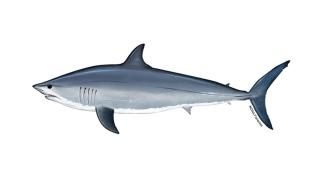
Identification:
The Atlantic shortfin mako shark (Isurus oxyrinchus) is known for its speed, reaching speeds of up to 43 mph (Fastest shark species). Shortfin mako sharks have very pointed snouts and long gill slits with dark blue/dark grey backs, light metallic blue sies, and white underbellies. Compared to the longfin mako shark, the shortfin mako shark has much shorter pectoral fins than the longfin mako. Shortfin mako sharks also have smaller eyes and the underside of their snout is a lighter color compared to the longfin mako. Shortfin mako sharks have very long teeth, with many frequently protruding from the mouth, especially in larger individuals. Shortfin mako sharks are built for speed, with a highly hydrodynamic coni-cylindrical body and a high aspect ratio (ratio of height to length) in the tail. This allows the shark to produce maximum thrust with minimum drag providing a great deal or propulsion.
Habitat:
The shortfin mako is a true pelagic species with a worldwide distribution. Off the East Coast, Atlantic shortfin mako sharks are found from New England to Florida, the Gulf of America, and the Caribbean Sea. They are a highly migratory species and can travel across the entire ocean. Juveniles are common in coastal waters, from the low-tide line to the edge of the continental shelf. Adults are primarily found offshore.
Species Info:
Shortfin mako sharks are a very active species of shark. They are often seen breaching the water surface when feeding. Like most sharks, shortfin mako sharks grow slowly. They can reach up to 13 feet in length and can live to be over 30 years old. Shortfin mako sharks are not able to reproduce until they are about 8 years old (~6 feet) for males and 19 years old (~9 feet) for females. They have a long reproductive cycle of 3 years, with a gestation period of approximately 18 months. Mating occurs from summer to fall, with eggs fertilized internally and developing inside of the mother. Females bear live pups; they are born approximately 2 feet long. This large size helps to reduce the number of potential predators and increase the chance of survival for the pups. The mean litter size is 12 with up to 30 pups being reported. Shortfin mako sharks are aggressive predators that feed near the top of the food web. They are known to target bluefish, swordfish, tuna, marine mammals, and other sharks. They have few predators, mainly larger sharks that may prey on smaller shortfin mako sharks.
Regulations & Management:
Shortfin mako sharks are seen as one of the great gamefish and are listed as such by the International Game Fish Association (IGFA). Commercially, the shortfin mako shark is highly sought after. NOAA Fisheries, through the Atlantic Highly Migratory Species Division, manage the Atlantic shortfin mako shark fishery in the United States. NOAA Fisheries implemented regulations consistent with the new ICCAT requirements adopted in 2021, based off a 2017 stock assessment of shortfin mako sharks. Atlantic sharks are managed under the Consolidated Atlantic Highly Migratory Species Fishery Management Plan. Management of highly migratory species, such as shortfin mako sharks, is complicated and requires international cooperation, with NOAA Fisheries continuing to take action at the international level to end overfishing of the species and make a rebuilding plan for the stock. As of July 5, 2022, U.S. fisherman may not land or retain any Atlantic shortfin mako sharks.
Rhode Island Minimum Size & Possession limits can be found here: Marine Fisheries Minimum Sizes & Possession Limits | Rhode Island Department of Environmental Management
Sources:

Little skate. Credit: Robert Jon Golder

Winter skate. Credit: Robert Jon Golder
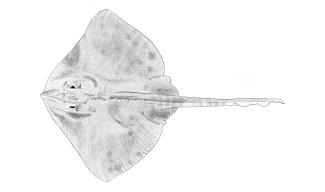
Barndoor skate. Credit: Julia Livermore

Clearnose skate. Credit: Robert Jon Golder

Thorny skate. Credit: Julia Livermore

Smooth skate. Credit: Julia Livermore

Rosette skate. Credit: Julia Livermore
Identification:
- Little skate - Leucoraja erinacea
- Little skates color varies from dark brown to grey with lighter spots near the pectoral fins and snout on top and a white underside. They are kite shaped with round edges and small spines which cover most of their back. They average in size 14-20 inches in length.
- Winter skate - Leucoraja ocellata
- Winter Skates are light brown and covered with small dark spots on top and a white underside. They are kite shaped with small spines which cover most of their back. They are very similar in appearance to little skates but can be differentiated by their larger size, growing to an average of 40 inches in length.
- Barndoor skate - Dipturis laevis
- Barndoor skates are reddish brown and covered with small dark spots, blotches, lighter streaks on top, grey under the wings. They are kite shaped with a defined pointed snout, a shorter tail and grow to an average of 30 inches in length.
- Clearnose skate - Raja eglanteria
- Clear nose skates range from light brown to grey with darker spots and spotted lines on top and a white underside. They are named after the translucent area at the triangle of their pointed snout and can also be characterized by the presence of a single row of thorns that runs down the center of its body to the tail. Their bodies are kite shaped and on average reach 29 inches in length.
- Thorny skate - Amblyraja radiata
- Thorny skates are muddy brown on top and a white underside with no spotting on the wings. They are named after the thorny denticles scattered along their spines, tails, and edges of their pectoral fins. The species can be characterized by the abundance of large thorns, their tails have a maximum of 10 large thorns, and their shoulders have 2 to 3 large thorns. Their bodies are kite shaped, their tail is shorter than their body, and grow on average between 28 and 29 inches in length depending on the region they live in.
- Smooth skate - Malacoraja senta
- Smooth skates are pale brown on top and paler on the bottom with darker spots lining the outer edge of the pectoral fins. They are named after their lack of hard spines on their wings and abdomen but do have 2 rows of small spins along the tail. Their bodies are narrow and kite shaped with a pointed snout, reaching an average of 22 to 24 inches in length.
- Rosette skate - Leucoraja garmani
- Rosette skates are brown with lighter spots on the pectoral fins and a pale yellow to white underside They are named after the dark brown rosette shaped spots that appear on the shoulders and pectoral fins surrounding the center of the body. Their bodies are kite shaped with pectoral fins that are broadly rounded and a tail that is longer than its body. Rosette skates are the smallest skate species among the seven managed under The Northeast skate complex fishery, reaching an average of 16 inches in length.
Habitat:
Skates are not known to migrate far, but they do move with the seasons as temperatures rise and fall, generally moving offshore during the summer and inshore during winter and spring. They most commonly inhabit waters in the Greater Atlantic region from Maine to Cape Hatteras and exist both inshore and offshore to waters on the edge of the continental shelf. Skates are a benthic species, meaning they reside on or near the ocean floor, typically on sand, mud, or gravel bottoms, in shallow depths and in depths exceeding 700 meters, depending on the specific species.
Species Info:
Due to the similar habitats and biology of the seven skate species listed, they are all managed under the northeast skate complex. In general, skates feed on a variety of organisms such as crustaceans, mollusks, worms, squid, and small fish. They are long living species living from 6 years to 20 years old depending on species and reproducing at later ages in their respective lifetimes. All skate species lay their eggs year rounds and have few offspring. Their eggs are enclosed in what you may know as a “mermaid purse” which is a hard leathery case with pointed edges. These eggs incubate on average for 6 to 12 months, and young skates have the adult form when they hatch.
Regulations & Management:
The primary target species for regulation and management are winter and little skates. This is due to commercial importance. Winter skate's wings are harvested for human consumption, and little skates are harvested for use as bait in lobster and other fisheries. For this reason, skates are harvested under two different fisheries, one for human consumption (winter skate wings) and one for lobster bait (little skates).
All seven skate species listed above are managed under The Northeast skate complex fishery, which is overseen by the New England Fishery Management Council (NEFMC) with NOAA serving as the implementing body for rules and regulation within the fishery. Under the Northeast Skate Complex Fishery Management Plan the following rules and regulations exist:
- Valid open access permit is required to catch, possess, transport, or sell skate.
- Annual catch limits for winter, little, clear nose, and rosette skates, as well as response measures if the catch limit is exceeded.
- Fishermen are prohibited from retaining smooth, barndoor, and thorny skates.
- Trip limits.
- Fishermen and dealers must report their catch by species.
See our latest Annual Fisheries Report for details about recent harvest.
Sources:

Identification:
The smooth dogfish (Mustelus canis) is a small, slender shark with elongated cat-like eyes, triangular fins, and an asymmetrical, notched caudal (tail) fin. The coloration of the smooth dogfish varies from gray to brown with the underside a yellowish gray to white. It has a tapering, blunt snout and a spiracle behind each narrow eye. Unlike most sharks, this dogfish has rows of flat grinding teeth, ideal for crushing and chewing crustaceans and mollusks. It has two large spineless dorsal fins with the first dorsal slightly larger than the second. The second dorsal fin is approximately twice as large as the anal fin and positioned slightly anterior to the anal fin. The lower lobe of the tail is rounded and much shorter than the upper lobe. The rear edge if the upper lobe has a deep notch near the tip.
Habitat:
The smooth dogfish is one of the most abundant sharks on the east coast of the U.S, commonly found on the continental shelves, bays, and other inshore waters. The species prefers shallow waters of less than 60 feet (18 m) in depth but may be found to depths of 655 feet (200 m). Its range is primarily the western Atlantic Ocean, from Massachusetts to Florida (U.S.), and from southern Brazil to northern Argentina. This species can be occasionally found in freshwater, although it is unlikely they can survive in freshwater for extended periods of time.
Species Info:
The smooth dogfish migrates seasonally, moving north in the spring and south in the fall. It is primarily a nocturnal species. The smooth dogfish has been documented at a maximum total length of 59 inches and a maximum weight of 27 pounds. Smooth dogfish reach maximum size at 7 to 8 years of age. The average length of this species is 48 inches. Females can live up to 16 years of age while males have a life span of 10 years. Smooth dogfish grow quickly, with males reaching maturity at 2 to 3 years of age and females at 4 to 5 years of age. Smooth dogfish are known to be scavengers and opportunistic predators, primarily feeding on crustaceans, including lobsters, shrimp, and crabs, as well as small fish and mollusks. Other shark species like dusky sharks, blacktip sharks, and great hammerhead sharks are known predators of the smooth dogfish.
Regulations & Management:
The smooth dogfish is managed under the Atlantic States Marine Fisheries Commission (ASMFC) Interstate Fishery Management Plan for Atlantic Coastal Sharks and NOAA Fisheries Highly Migratory Species (HMS) Fishery Management Plan. ASMFC sets measures and states implement them locally. NOAA is working toward a coastwide commercial quota; in the absence of a stock assessment, no specific commercial quota or possession limits are set. The Shark Conservation of 2010 allows fin removal at sea for smooth dogfish if fins weigh less than or equal to 12 percent of the shark’s carcass weight. Under the Shark Fin Sales Elimination Act (2022), smooth dogfish fins are ban on shark fin sales, but other species are not. ASMFC Addendum II permits limit at-sea processing of smooth dogfish, including finning, with identification requirements.
See our latest Annual Fishery Report for recent harvests.
Rhode Island Minimum Size & Possession limits can be found here: Marine Fisheries Minimum Sizes & Possession Limits | Rhode Island Department of Environmental Management
Sources:

Identification:
Spiny dogfish (Squalus acanthias) are slim, with a narrow, pointed snout and characteristic white spots. Spiny dogfish are grey on the top and white below. They have two dorsal fins with ungrooved large spines giving the species its name.
Habitat:
Spiny dogfish are found in the North Atlantic and North Pacific Oceans, mostly in the temperate and subarctic areas. In the Northwest Atlantic, they are found from Labrador to Florida and are most abundant between Nova Scotia and Cape Hatteras. Spiny dogfish live both inshore and offshore, typically residing near the bottom but also in mid-water and at the surface.
Species Info:
Like all sharks, dogfish grow slowly and mature later in life with a long-life span (35 to 40 years). Females grow larger and mature later than males, with males growing up to 3.3 feet and females reaching up to 4 feet. Females are first able to reproduce at age 12 compared to age 6 for males. They spawn in winter offshore. Females have between 2 and 12 eggs per spawning season. Eggs are fertilized internally and, after a gestation period of 18 to 24 months, female dogfish bear live young (average of 6 pups). They are opportunistic feeders, preying on whatever is most available. Smaller spiny dogfish tend to feed primarily on crustaceans, while larger dogfish like to eat jellyfish, squid, and schooling fish. Dogfish are preyed upon by cod, red hake, goosefish, other spiny dogfish, larger sharks, seals, and orcas. Spiny dogfish swim in large schools and migrate seasonally with changes in water temperature. Much of the population travels north in the spring and summer, and south in the fall and winter. Most spiny dogfish remain in northern waters throughout the year and move offshore during the winter.
Regulations & Management:
NOAA Fisheries, the Mid-Atlantic and New England Fishery Management Councils, and the Atlantic States Marine Fisheries Commission manage the Atlantic spiny dogfish fishery. The Mid-Atlantic Council leads the joint management of the Spiny Dogfish Fishery Management Plan. This plan requires fisherman to have a permit to harvest spiny dogfish, annual catch limits and a commercial quota are set, and trip limits are used to control the catch rate. The spiny dogfish fishery, which operates from May 1 through April 30, is managed through an annual commercial quota, which is further allocated by state shares. The Atlantic States Marine Fisheries Commission implements the Interstate Fishery Management Plan for Spiny Dogfish in state waters, establishing complementary regulations to the federal regulations.
In Rhode Island, there is no minimum size for spiny dogfish. The current commercial possession limit is 7500 lbs./day. Rhode Island Minimum Size & Possession limits can be found here: Marine Fisheries Minimum Sizes & Possession Limits | Rhode Island Department of Environmental Management
Sources:

Identification:
Striped bass (Morone Saxatilis) are a large species, capable of exceeding 50 pounds in weight, and 45 inches in length. These fish have a streamlined body with a silver color near the belly, and an olive or brown color on top, and 7-8 dark horizontal stripes across the side of the fish’s body. Striped bass have two dorsal fins, the first of which contains several spines. They can also be identified by their largemouth that possesses pads of gripping teeth and feels similar to sandpaper.
Habitat:
On the East Coast striped bass rang from the St. Lawrence River in Canada to the St. Johns River in Florida and in the Gulf of America from Florida to Louisiana. On the West Coast the species was introduced to inland lakes and reservoirs in the 1870s where they are now found from Mexico to British Columbia. Striped bass are anadromous, meaning they live in the ocean but return to freshwater habitats to spawn. In the spring, mature striped bass migrate to freshwater or brackish water to spawn. After spawning, larvae drift downstream toward nursery areas in river deltas and inland areas of coastal sounds or estuaries. After this, juveniles typically remain in estuaries for 2 to 4 years and then migrate to the Atlantic Ocean. Some striped bass spend the majority of their lives in rivers or coastal estuaries while others spend the majority of their adult life in the ocean. Adults who inhabit the Atlantic Ocean are known to migrate seasonally.
Species Info:
Striped bass, often called “stripers” or “rockfish” are a frequently encountered species in Rhode Island for most of the year. The numbers of striped bass in Rhode Island vary depending on the time of year due to their migration. In the spring, migration brings striped bass northward as far as Canada. In the fall, the migration flips, with the striped bass moving southward, chasing warmer waters and food. Striped bass are perhaps the most popular marine gamefish in the northeast. These fish have a broad diet, eating anything from small fish and eels, to crustaceans, worms, and squid.
Regulations & Management:
The Atlantic striped bass fishery is predominately recreational with the recreational sector accounting for over 80% of total removals by number each year since 1985. The fishery for striped bass is managed by the Atlantic States Marine Fisheries Commission through the interstate fishery management plan. The management plan sets harvest limits to prevent overfishing. See our latest Annual Fisheries Report for details about recent harvest.
Rhode Island Minimum Size & Possession limits can be found here: Marine Fisheries Minimum Sizes & Possession Limits | Rhode Island Department of Environmental Management
Sources:

Identification:
The striped sea robin (Prionotus evolans) is elongated with a bony rounded head that thins out at the back of the fish growing from 12 to 16 inches in length. They are red, gray or brown in color on the upper side of the body, and lighter on the lower side. The pectoral fins have a wing-like appearance and are red and brown in color, while the pelvic fins are white in color. They are distinguishable from the northern sea robin due to distinct horizontal stripes that are on the abdomen.
Habitat:
Striped sea robin range in depths from 9-146 meters but are typically found from 18-64 meters. They are native to the western Atlantic Ocean, with a range extending from Nova Scotia in the north southward along the U.S. Atlantic coast to southeastern Florida and also found around Bermuda. They are rare north of Cape Cod, Massachusetts. These fish are typically in shallow coastal waters on sandy or muddy bottoms in estuaries, nearshore areas, and inland bays.
Species Info:
Sea robins get their name from their fan-shaped pectoral fins which open and close rapidly when they swim, giving them a wing-like appearance.
Sea robins can cluck, bark, and growl using their swim bladders. Science hasn’t proven any behavioral context associated with these sounds yet. However, when a sea robin does its staccato call, it is more likely associated with its reproductive behavior. Striped sea robin feed on crustaceans, cephalopods, gastropods, bivalves, amphipods, eggs, other fish and seaweed.
Regulations & Management:
In Rhode Island, the striped sea robin is not currently managed as a separately regulated species in the way that other popular species are. Rhode Island Department of Environmental Management Division of Marine Fisheries (RIDEM DMF) typically focus on species with significant commercial or recreational harvest pressure. Commercial harvest of striped sea robin is not managed through species specific quota or possession limits comparable to other major managed finfish species, currently there is:
- No specific minimum size limit for striped sea robins
- No specific recreational bag limit listed for striped sea robins
- No dedicated season for recreational harvest of striped sea robins
However, anglers must still comply with general Rhode Island saltwater fishing laws, including requirements and any gear restrictions that apply to marine finfish harvest.
Rhode Island Minimum Size & Possession limits can be found here: Marine Fisheries Minimum Sizes & Possession Limits | Rhode Island Department of Environmental Management
Sources:

Identification:
Summer Flounder (Paralichthys dentatus), sometimes called fluke, are a left-facing species of flatfish. Fluke are colored on their upper side. The side which faces the ocean floor is white. The colored side of their body is usually a brown or grayish color, allowing them to blend in with the surrounding ocean floor. These flatfish can change their coloration to better camouflage with the bottom type. One distinguishing feature of summer Flounder are the dark spots that often form an “X” pattern across their backs. At the head, summer flounder have large mouths filled with sharp, pointy teeth. Females can reach sizes up to 36 inches, which is larger than males, who can grow up to 24 inches.
Habitat:
They are commonly found on sand flats, marsh creeks, and seagrass beds. Summer flounder migrate offshore to spawn during the fall and early winter months. Their migration is dictated by seasonal changes in water temperature.
Species Info:
Summer Flounder are ambush predators whose diet includes fish, squid, shrimp, and other invertebrates. They can be found in the Atlantic Ocean, being most common in the mid-Atlantic region. They prefer being on the ocean floor where they can cover themselves in sand or camouflage to hide from predators and can go unnoticed by prey.
Regulations & Management:
Management of summer flounder fisheries is highly cooperative, with NOAA Fisheries, the Mid-Atlantic Fishery Management Council and the Atlantic States Marine Fisheries Commission all being involved. These organizations manage the summer flounder fishery in both state and federal waters. The Summer Flounder, Scup, and Black Sea Bass Fishery Management Plan is the main tool used in the management of summer flounder. This fishery management plan uses catch limits and other tools to keep harvest at healthy and sustainable levels. See our latest Annual Fisheries Report for details about recent harvest.
Rhode Island Minimum Size & Possession limits can be found here: Marine Fisheries Minimum Sizes & Possession Limits | Rhode Island Department of Environmental Management
Buy locally caught summer flounder! According to NOAA, summer flounder is a “smart seafood choice” thanks to sustainable management and responsible harvest. Here’s where to find what’s being caught by fishermen, and where to buy locally caught summer flounder:
- RI Seafood Finder | Rhode Island Seafood Marketing Collaborative
- Weekly Landing Data | Rhode Island Seafood Marketing Collaborative
Sources:

Identification:
Tautog (Tautoga onitis) are typically either a brown or black in color. Coloration of tautog can vary depending on sex and habitat, but typically they have an irregular pattern of dark and light spots, with a lighter grey or white belly. Males can be distinguished by their white chin, which protrudes downwards. Tautogs have a distinct stout build with a blunt snout. Their mouths have thick lips and sturdy, robust teeth. Tautog typically grow to be around 3 to 7 pounds but can grow larger.
Habitat:
Tautog can be found along the East coast of North America, with the majority being found between Cape Cod and the Chesapeake Bay. Tautog prefer areas with structure, such as jetties, piers and even shipwrecks. As juveniles, they can be found utilizing vegetation in shallow waters for cover, and as they grow, they move to deeper coastal waters.
Species Info:
With their blunt snout and strong jaws, tautog can scrape mussels and other shellfish from rocks on the bottom. They have sharp incisor-like teeth at the front of their mouth, and powerful molars at the back of their mouths, which are perfect for crushing the shells of their prey.
Regulations & Management:
Tautog are managed regionally under a fishery management plan. In Rhode Island’s region, the stocks are at healthy levels, and the fishery is managed using minimum sizes, bag limits, seasonal closures, and yearly harvest limits (quotas). See our latest Annual Fisheries Report for details about recent harvest.
Rhode Island Minimum Size & Possession limits can be found here: Marine Fisheries Minimum Sizes & Possession Limits | Rhode Island Department of Environmental Management
Buy locally caught tautog!
- RI Seafood Finder | Rhode Island Seafood Marketing Collaborative
- Weekly Landing Data | Rhode Island Seafood Marketing Collaborative
Sources:
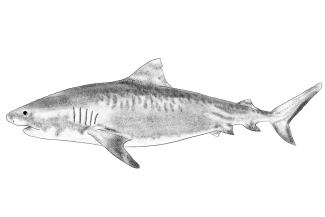
Identification:
The tiger shark (Galeocerdo cuvier) is named for their distinctive color pattern. The body is gray with dark gray vertical bars or spots on the flanks and a pale or white underside. These markings are especially distinctive in juveniles, but this diminishes with age. The head of the tiger shark is fitted with large eyes and a blunt and wide snout. The anterior portion of the body is stout but becomes increasingly slender posterior to the abdomen. A ridge is present along the back between the two dorsal fins.
Habitat:
The tiger shark is found throughout the world’s temperate and tropical waters, with exception of the Mediterranean Sea. It is wide-ranging species that is at home both in the open ocean and as well as shallow coastal waters. Individuals have been reported as far north as Iceland and the United Kingdom. The tiger shark has a notable tolerance for many kinds of marine habitats but will generally prefer murky waters in coastal areas. They are commonly found in river estuaries, harbors, and other inlets where runoff from land provides suitable habitat for a variety of prey items.
Species Info:
Tiger sharks are one of the largest shark species, with individuals commonly reaching lengths between 10 to 14 feet and weighing between 850 to 1400 lbs. Males reach sexual maturity between 7 to 9 feet and females mature between 8 to 10 feet. The largest individuals can grow up to 18 feet and weigh an estimated 2000 lbs. Tiger sharks are known to eat almost anything they come across. Preferred prey varies depending upon geographical region but commonly includes sea turtles, rays, other sharks, bony fishes, sea birds, dolphins, squid, and various crustaceans. It is not uncommon to find objects of human origin in tiger shark stomachs. Tiger sharks have a long gestation period between 13 to 16 months. After the gestation period, females can give birth anywhere from 10 to 82 pups. In the Northern Hemisphere, mating takes place between March and May and the young are born between April and June of the following year. Tiger sharks undergo seasonal migrations, moving into temperate waters from the tropics in warmer months and returning to the tropics during the winter. They also make long oceanic migrations between islands and can travel long distances in a short amount of time.
Regulations & Management:
Under the authority of the Magnuson-Stevens Fishery Conservation and Management Act (MSA), NOAA Fisheries manages sharks in U.S. federal waters using fishery management plans. The Shark Finning Prohibition Act of 2000 amended the MSA to prohibit shark finning (a process in which the fin of the shark is removed at sea and the rest of the shark is discarded) in the United States. The law prohibits any person under U.S. jurisdiction from engaging in the finning of sharks, possessing shark fins aboard a fishing vessel without the corresponding carcass, and landing shark fins without the corresponding carcass. The Shark Finning Prohibition Act also requires NOAA Fisheries to provide Congress with an annual report describing NOAA’s efforts to implement the law. On January 4, 2011, the Shark Conservation Act of 2010 was signed into law, amending the High Seas Driftnet Fishing Moratorium Protection Act and the MSA. The Shark Conservation Act requires that all sharks in the United States, with one exception (smooth dogfish), be brought to shore with their fines naturally attached. The Shark Fin Sales Elimination Act was enacted in 2023 enforcing the following regulations:
- Prohibited the possession, transport, sell, or purchasing of any shark fins or tails.
- Any fin or tail of a shark must be destroyed or disposed of immediately upon separation from the carcass
- No exceptions from these provisions are provided for commercial purposes, but there are exceptions for scientific activities, noncommercial subsistence purposes, and for two sharks species in the Atlantic (smooth dogfish and spiny dogfish)
In the state of Rhode Island, per Rhode Island Department of Environmental Management, Tiger Sharks are identified as a prohibited species.
Sources:

Identification:
The tomcod (Microgadus tomcod) holds a unique place in the marine ecosystems of the North Atlantic. The tomcod is a small to medium-sized fish that is integral to the marine food web. It has an elongated body and a pointed snout that distinguishes it from other fish. The coloration is usually bluish green to gray on the back, fading to a lighter silver or white on the belly. The tomcod also has a distinctively spotted pattern along its sides, which can vary in intensity but is generally easier to notice in younger specimens. The tomcod also has two separate dorsal fins; the first is small and located far back, while the second is longer and more prominent.
Habitat:
Tomcods are primarily found in estuarine and coastal waters, where they can take advantage of both fresh and saltwater resources. They can be found along the northeastern coast of North America. Their range extends from Newfoundland and Labrador down through the Gulf of Maine to New Jersey. Their adaptability to various salinity levels allows them to thrive even in polluted waters, although this can sometimes affect their health and reproductive success.
Species Info:
Tomcods are generally social fish, often found in schools, particularly during their juvenile stages. As they mature, they may become more solitary. They are known to be opportunistic feeders, often foraging in groups to exploit available food resources.
Atlantic tomcod are an important subject of scientific study due to their unique genetics. Research is particularly focused on pollution and environmental stressors.
Regulations & Management:
In Rhode Island, there is not a major directed commercial fishery for tomcod and there are currently no species-specific regulations for tomcod. Instead, they are managed under Rhode Island’s broader marine fisheries framework administered by the Rhode Island Department of Environmental Management Division of Marine Fisheries (RIDEM DMF).
Management is primarily ecosystem-based rather than quota-based:
- Protection of estuarine and coastal habitats
- Monitoring through marine fisheries surveys and environmental programs
- Coordination with regional fisheries and habitat-management efforts
- Enforcement of general marine fisheries regulations where applicable
RIDEM DMF recognizes factors that can affect their population including:
- Loss or degradation of estuarine spawning habitat
- Barriers to migration in tidal streams and rivers
- Pollution and contaminant exposure in urban estuaries
- Changes in water temperature and coastal ecosystems
Sources:

Identification:
Weakfish (Cynoscion regalis) typically reach sizes from 12-16 inches, but they may be larger. Weakfish possess a streamlined body exhibiting silvery white coloration along the belly which transitions to iridescent brown speckles along the back of the fish. The pectoral, pelvic, and anal fins are all highlighted with a bright yellow. The fish’s second dorsal fin is longer than its first. The mouth of the fish features distinct teeth, with a sharp row of pointed teeth along the bottom jaw, contrasted with two fangs fixed to the roof of the fish’s mouth.
Habitat:
Although weakfish are found up and down the east coast from Nova Scotia, Canada to as far south as Florida, the majority the weakfish population sticks closer to the middle of that range, inhabiting waters between New York and North Carolina. This range leaves many weakfish south of Rhode Island. Weakfish typically like to eat smaller animals such as shrimp, smaller baitfish species, and crustaceans. Like many other marine fish native to Rhode Island, weakfish are a migratory species, spending their winters offshore in the warmer waters down south. By the time the water warms up in the spring, weakfish move north, seeking shallower waters where they can spawn. After spawning, the fish hang around before heading southward as water temperatures drop in the fall.
Species Info:
Weakfish, also known as squeteague, are somewhat uncommon in Rhode Island, thanks to both their range, and fishery depletion, which has been a lingering problem with this species since the 1990s. In recent years, there have been reports of them being caught in late spring and early fall. Some anglers consider them elusive but predictable once you know their habits.
Regulations & Management:
Management of the Weakfish fishery is conducted by the Atlantic States Marine Fisheries Commission, through an interstate management plan. This plan promotes research to better understand weakfish population dynamics. Besides this, the plan also prescribes restrictions, by keeping young fish out of the fishery.
See our latest Annual Fisheries Report for details about recent harvest.
Minimum sizes & possession limits can be found here: Marine Fisheries Minimum Sizes & Possession Limits | Rhode Island Department of Environmental Management
Sources:
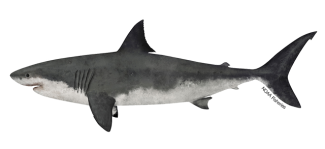
Identification:
The white shark (Carcharodon carcharias) is one of the world’s most famous shark species. The white shark gets its name from its white-colored underside. The top side of the white shark is gray to brown. Like other “mackerel sharks” (mako, porbeagle, and salmon sharks), the white shark has a torpedo-shaped body with a conical snout and prominent keel at the base of its crescent-shaped tail. The white shark is the largest shark in the mackerel shark family. It has a large first dorsal fin, which typically has a pointed apex (tip). There are often black spots on the underside of the pectoral fins. White shark teeth are broad and triangular with distinct serrations. However, the lower teeth are typically narrower.
Habitat:
The white shark can be found worldwide in temperate and subtropical waters, often migrating seasonally to follow its preferred temperature range (~ 50-80 °F). In the western Atlantic, they range from Maine to the Gulf of America and the Caribbean. In the U.S. Pacific, they range from Alaska to California and Hawaii. They also live in waters off the Pacific coast of Mexico. There are nursery areas for juvenile white sharks in near-shore waters of southern California and off Long Island, New York. White sharks occur both near-shore coastal waters and offshore pelagic waters. Their preferred habitats shift with age, pups and juveniles tend to remain in near-shore habitats over shallow continental shelves, in warmer waters. As they age and their diets change, they split their time between seal and sea lion rookeries and pelagic habitats.
Species Info:
The white shark grows slowly. Males mature at approximately 26 years old and females at approximately 33 years old. Maximum age is hard to determine, and estimates range from 30 to over 70 years old. The white shark is born at approximately 4 feet long and can grow up to about 20 feet long, weighing over 4000 pounds. The white shark has a diverse diet of fish, invertebrates, and marine mammals. Juvenile white sharks will mainly eat bottom fish, smaller sharks and rays, and schooling fish and squids. Larger white sharks often gather around seal and sea lion colonies and will occasionally scavenge dead whales when the opportunity arises.
Regulations & Management:
The white shark is a prohibited species in all U.S. waters and fisheries. There are no commercial fisheries for white sharks, but they are occasionally caught as bycatch. In the Atlantic, the white shark is managed under the 2006 Consolidated Atlantic Highly Migratory Species Fishery Management Plan. In the Pacific, it is managed by the Pacific Fishery Management Council under the West Coast HMS Fishery Management Plan. There are complementary management measures protecting the white shark in state waters along both the East and West coast. The white shark is further protected in some of NOAA’s National Marine Sanctuaries. The white shark is also protected internationally under CITES Appendix II, CMS Appendix II, UNCLOS, and other international regional fisheries management organizations. Harvest of white sharks is prohibited, any white sharks caught, recreational or commercially, must be released immediately.
Rhode Island Minimum Size & Possession limits can be found here: Marine Fisheries Minimum Sizes & Possession Limits | Rhode Island Department of Environmental Management
Sources:

Identification:
Winter Flounder (Pseudopleuronectes americanus) are a right-facing flatfish. They have an oval shaped body with a straight lateral line and dark coloring on their upper side. Their coloring varies depending on their habitat, ranging from a reddish brown to an olive green. In some cases, they can even appear black, which is where they get their nickname “Black back”. The side that faces the ocean floor is white. Their coloration helps them to camouflage themselves with the surrounding ocean floor. Another distinguishing feature of winter flounder is their small, toothless mouth, and blunt snout.
Habitat:
Winter flounder are a flatfish native to Rhode Island, although they can be found as far north as Newfoundland, and as far south as North Carolina. Inside of this range, they are dispersed anywhere from estuaries, to as far out as the continental shelf. This dispersal between inshore and offshore waters depends largely on their migration. In the winter, these fish move inshore to spawn, where they prefer to live on sand, clay or gravel ocean floor. Their presence in nearshore waters during wintertime is where the name winter flounder comes from.
Species Info:
During the late spring and summertime, they make their way offshore. Winter flounder have quite small mouths, because of this they are limited to eating smaller prey. They prefer to feed during the day, with their diet consisting of worms, clams, shrimp, and small invertebrates.
Regulations & Management:
In federal waters, winter flounder are managed cooperatively by NOAA Fisheries and the New England Fishery Management Council. In State waters, management is coordinated by the Atlantic States Marine Fisheries Commission, and the New England Fishery Management Council, through the Northeast Multispecies Fishery Management Plan (Groundfish FMP). This fishery management plan prescribes a variety of measures, to ensure the health of the fishery, and maintain sustainable harvest levels.
See our latest Annual Fisheries Report for details about recent harvest.
Rhode Island Minimum Size & Possession limits can be found here: Marine Fisheries Minimum Sizes & Possession Limits | Rhode Island Department of Environmental Management
Buy locally caught winter flounder! According to NOAA, winter flounder is a “smart seafood choice” thanks to sustainable management and responsible harvest. Here’s where to buy locally caught winter flounder:
- RI Seafood Finder | Rhode Island Seafood Marketing Collaborative
- Weekly Landing Data | Rhode Island Seafood Marketing Collaborative
Sources:

Identification:
Yellowfin tuna (Thunnus albacares) is among the most popular and sought after gamefish in the world. The yellowfin tuna is torpedo-shaped with a metallic dark blue on the back and upper sides and change from yellow to silver on the belly. True to their name, their dorsal and anal fins and finlets are bright yellow. Yellowfin tuna can be distinguished from other tunas by their long, bright yellow dorsal fin and a yellow strip down the side. They are also more slender than bluefin tuna.
Habitat:
Yellowfin tuna are highly migratory and can swim across an entire ocean. Juvenile yellowfin tuna travel in schools with skipjack and juvenile bigeye tuna. Yellowfin tuna are typically found near the surface of tropical and subtropical oceans around the world.
Species Info:
Yellowfin tuna grow fairly fast, up to 400 pounds, and have a somewhat short life span of about 7 years. They are a highly sought after gamefish with many anglers targeting the species offshore. They are prized for their speed, strength, and fighting ability. Fresh yellowfin tuna is also considered one of the finest table fish, with a rich, buttery flavor and tender texture.
Regulations & Management:
NOAA Fisheries and the Atlantic Highly Migratory Species Division manage the Atlantic yellowfin tuna fishery in the U.S. Yellowfin tuna are managed under the 2006 Consolidated Atlantic Highly Migratory Species Fishery Management Plan and amendments:
- Commercial fishermen must have a permit to harvest yellowfin tuna.
- Gear restrictions.
- Time/area closures.
- Minimum size limit.
- Federal management in state waters expect in Maine, Connecticut, and Mississippi.
Highly migratory species, like yellowfin tuna, have complicated management that requires international cooperation.
- The U.S. participates in regional fisheries management organizations, such as the International Commission for the Conservation of Atlantic Tunas (ICCAT), to enhance tuna management worldwide.
- NOAA Fisheries sets regulations for the U.S. western Atlantic yellowfin tuna fishery based on science as well as conservation and management measures adopted by ICCAT.
U.S. landings of Atlantic yellowfin tuna generally represent a small percentage of the total international landings of Atlantic yellowfin tuna. Since anglers typically target yellowfin tuna offshore, angler have to follow federal regulations set by NOAA fisheries with Rhode Island Department of Environmental Management, Division of Marine Fisheries (DMF) assisting.
Sources:
Invertebrates
There are thousands of marine invertebrates in Rhode Island. This is just a small sampling of species that may be of interest.

Identification:
The American Lobster (Homarus americanus) is a well-known staple of Rhode Island. They can be identified by their large shrimp-like body and a hard exoskeleton, with an olive green or greenish brown coloring. They have two larger claws in the front, where the biggest one is used for crushing and the smaller one is used for shredding. The American lobster also has two large antennae present.
Habitat:
The American Lobster can be found in the northwest Atlantic Ocean in coastal waters or offshore depths of up to 2,300 feet. They live on the ocean floor in places where they can easily find shelter, such as rocky areas, mud bottoms, or underwater canyons. These lobsters are very territorial and live alone.
Species Info:
The smaller lobsters closer to the coast do not travel much, while the larger lobsters further out travel much more. They migrate during the springtime, sometimes traveling 50 to 190 miles.
Regulations and Management:
The American lobster fishery is managed under the Interstate Fishery Management Plan (IFMP) for American lobster. The plan was developed by the Atlantic States Marine Fisheries Commission and implemented by states and NOAA Fisheries. American lobsters are managed under Amendment 3 to the FMP and its Addenda (I – XXVI). The goal of the management plan is to maintain a healthy lobster stock and a management regime which provides continued harvest, opportunities for participation, and cooperative development on conservation measures by all stakeholders.
In Rhode Island, Rhode Island Department of Marine Fisheries, sets minimum size requirements, possession limits, and trap requirements for American lobsters. Permits are also required to legal harvest American lobster in Rhode Island waters. All legal egg-bearing females are “V-notched” and must be released immediately.
Rhode Island Minimum Size & Possession limits can be found here: Marine Fisheries Minimum Sizes & Possession Limits | Rhode Island Department of Environmental Management
Lobsters, Crabs and Other Crustaceans - Rhode Island Department of State
See our latest Annual Fisheries Report for details about recent harvest.
Sources:

Identification:
The Asian shore crab (Hemigrapsus sanguineus) has a roughly square-shaped carapace, with a smooth texture and three anterior-lateral teeth. The third tooth is small. The frontal edge, between the eyes, is about half the width of the carapace. The males have a membranous welling at the base of the moveable finger on the claws. The claws are symmetrical, but males have proportionally larger claws than females. The carapace is mottled greenish brown, with small reddish spots on the upper surface of the claws.
Habitat:
The Asian shore crab is native to the rocky shores of the Western Pacific, from Sakhalin and Peter the Great Bay (Russia), Korea, Japan and China. It has been introduced to the East Coast and was first found in Cape May County, New Jersey in 1988 by a biology student on a class field trip. Ballast water is the most likely vector for its initial introduction, though ship/boat fouling and natural dispersal of larvae may contribute to its local spread. Asian shore crabs are associated primarily with natural and artificial intertidal rock habitats, but they have been collected in salt marshes and from subtidal habitats.
Species Info:
The Asian shore crab is most abundant in rocky intertidal habitats, but it has been collected in fouling communities in marinas and docks, in salt marshes, and in subtidal habitats down to 4 meters in depth. It is tolerant of rapid salinity changes, to 5 or 10 PSU, such as those that occur in tidepools and estuaries due to rainfall. Males show a stronger preference for high salinity (35 PSU) pools than females, but both are capable of moving out of water to find more favorable water conditions. In salt marshes, they are known to occur stony and debris-filled areas but will also occupy burrows of fiddler crabs. The Asian shore carb is omnivorous, and feeds on algae and a variety of invertebrates, including barnacles, snails, mussels, amphipods, and smaller crabs. Their diet varies greatly with seasons and regional and local prey availability. Adults tend to feed at night. The Asian shore crab is eaten by larger crabs, fishes, and shorebirds. However, it is considered to have no natural predators on the East Coast, some native species will feed on the Asian shore crab, but they have not played a major role in controlling its population and outcompeting native crab species.
Regulations & Management:
Currently, Rhode Island does not have a dedicated statue or fishery management plan aimed exclusively at Asian shore crabs. Instead, management occurs through broader aquatic invasive species programs led by Rhode Island Coastal Resources Management Council and Rhode Island Department of Environmental Management. The overall strategy includes:
- Monitoring invasive populations
- Preventing additional introductions
- Public education
- Research and ecological assessment
- Limit spread through boating and shipping practices
Rhode Island adopted a statewide Aquatic Invasive Species Management Plan through CRMC in 208. The plan supports rapid assessment surveys, monitoring programs, and coordination among agencies and researchers.
Management in Rhode Island and nearby New England states mainly emphasize containment and ecological monitoring rather than eradication.
Rhode Island Minimum Size & Possession limits can be found here: Marine Fisheries Minimum Sizes & Possession Limits | Rhode Island Department of Environmental Management
Sources:

Identification:
The Atlantic horseshoe crab (Limulus polyphemus) is known as a “living fossil” that has remained relatively unchanged for 350 million years. The horseshoe crab is not a true crab, rather it is a member of an ancient group of arthropods, closely related to spiders and scorpions. The horseshoe crab has a primitive body structure, composed of three parts: the prosoma (head), the opisthosoma (central area, body), and the telson (tail). The horseshoe crab’s name is derived from the prosoma, which resembles the shape of a horse’s shoe. The horseshoe crab is generally a dull olive green or brown in coloration when viewed from above with the underside more brown in appearance.
Habitat:
The horseshoe crab habitat requirements change throughout the horseshoe crab's life cycle, extending from intertidal beach fronts and tidal flats in coastal embayments for eggs and larvae, to the edge of the continental shelf for adults. The horseshoe crab has been described as ecological generalists (able to tolerate a wide range of environmental parameters throughout its distribution).
Horseshoe crabs range from the Gulf of Maine to Florida. The species range extends into the Gulf of America from Florida west into Louisiana and south to the Yucatan Peninsula. The species is considered to be absent from Texas to Tabasco, Mexico.
Species Info:
While referred to as the horseshoe crab, it’s not really a crab! It's actually a member of an ancient group of arthropods, closely related to spiders and scorpions. Horseshoe crabs are characterized by high fecundity, or the ability to have a large offspring, as well as high egg and larval mortality and low adult mortality. They are known to live fairly long lives, with individuals living more than 20 years.
Horseshoe crabs have significant medical uses, primarily due to their blood. Which contains a substance called limulus amebocyte lysate (LAL). This substance is essential for detecting pathogens in antibiotics and vaccines and ensuring the safety of many drugs and medical devices that are actively used in healthcare.
Regulations & Management:
Horseshoe crabs play a vital role in human medicine, making management of the species critically. In Rhode Island, fisheries management is administered primarily by the Rhode Island Department of Environmental Management (RIDEM), in coordination with the Atlantic States Marine Fisheries Commission (ASMFC). Horseshoe crabs are managed under the Interstate Fishery Management Plan for Horseshoe Crab (1988) and its subsequent addenda (Addenda I – VIII). Under Addendum I (2000), the Commission established state-by-state quotas in all Atlantic states for horseshoe crabs harvested for bait. For Rhode Island specifically there are specific rule and regulations for commercial, recreational, and biomedical fisheries. For more information regarding all regulations for horseshoe crabs, please visit the RIDEM Marine Fisheries minimum sizes and possession limits.
Rhode Island Minimum Size & Possession limits can be found here: Marine Fisheries Minimum Sizes & Possession Limits | Rhode Island Department of Environmental Management
Sources:

Identification:
The Atlantic mole crab (Emerita talpoida) goes by many different names including beach fleas, sand bugs, sand crabs, and sand fiddlers. Atlantic mole crabs are small, 1 inch in length or less with a grey, tan coloration. They have very short legs that they use to dig down backwards into the sand. Its sandy color keeps it camouflaged. Mole crabs are harmless - they do not have pincers and do not bite.
Habitat:
Very common on Rhode Island beaches. They are generally found burrowing in the sand in the swash zone.
Species Info:
This mole-like crab will burrow backwards into the sand and extend its antennae above the ground. This enables it to snag and filter algae and plankton as the waves wash overhead. The Atlantic mole crab has a number of predators including shorebirds, seagulls, blue and ghost crabs, and some fish.
The mole crab is commonly used as bait for surf casting.
Regulations & Management:
The Atlantic mole crab is not specifically regulated in Rhode Island in the same way as other popular invertebrate species such as lobster, Jonah crab, or horseshoe crab. Management is minimal and indirect since the species is generally not considered commercially important, overfished, or invasive in the state. Rhode Island Division of Marine Fisheries regulations do not currently contain a dedicated section for Atlantic mole crabs, and they are not commercially harvested at a meaningful scale in Rhode Island.
Sources:
Atlantic Sand Crab - Padre Island National Seashore (U.S. National Park Service)
Identification:
The Atlantic rock crab (Cancer irroratus) is found extensively along the North American east coast. The rock crab’s size varies considerably between males and females. A fully mature male can reach a width of 50 to 140mm with females rarely surpassing 100mm. The shape of a rock crab’s shell is wide and oval. It is a yellowish color and frequently shades of red and purplish brown are visible. The different array of colors gives this creature a unique and colorful carapace. Another interesting characteristic of the rock crab is its dentition, or teeth. The rock crab has either nine broad and smooth or rough jagged teeth, depending on its diet.
Habitat:
The Atlantic rock crab lives in the benthic zone of the ocean. They are able to adapt to extreme variations in depth. The depths that they exist at range from deep waters at 2600 to very shallow waters and occasionally well inland from low tide. They live on a variety of substrate types including rocky and loose material. Smaller crabs with the width of about 50 mm tend to inhabit muddy or sandy bottoms, while other crabs seem to prefer the rock bottom.
Species Info:
Rock crabs are opportunistic feeders. They eat an assortment of species including algae, polychaetas, mussels, gastropods, and various crustaceans including hermit crabs. Many times, rock crabs are often caught in lobster pots stealing bait from the traps and getting themselves captured as a result.
Regulations & Management:
Atlantic rock crabs in Rhode Island are managed under the state’s broader marine crustacean regulations, but compared with lobster, Jonah crab, or horseshoe crab, the fishery remains lightly regulated and relatively undeveloped. The species is regulated by the Rhode Island Department of Environmental Management (RIDEM) under these frameworks provided in the link.
Rhode Island currently treats Atlantic rock crab as an “open” or minimally regulated fishery.
Sources:

Identification:
The bay scallop (Argopecten irradians) is round with nearly symmetrical ‘wings’ on each side of the beak, prominent ribs radiating from the triangular beak, and scalloped edges. The lower and upper valve are equally convex. Color patterns of the shell vary, often with bands of light and dark along the growth lines, and varying among grey, brown, and white. The adult live animal is marked by the many blue eyes visible when the shell is open and by the rapid, jerky swimming caused by opening and closing its shell.
Habitat:
The range of the Atlantic Bay scallop extends from Cape Cod in Massachusetts to the Gulf of Mexico. It can even be found as far south as Colombia. Juvenile bay scallops will use byssus threads to attach to substrates such as gravel and eelgrass, but move freely as adults, swimming when disturbed. They range through estuarine habitats but depend on eelgrass for shelter from predators.
Species Info:
The Atlantic Bay scallop is a highly prized food item, known for its delicious taste and firm texture. The fishery for this species on the east coast is limited, and declining. This is credited mainly because of poor water quality, and loss of eelgrass beds in many estuaries. The high status and price of the bay scallop have led to introductions for aquaculture in China, and a hatchery-dependent ‘put and take’ fishery in Atlantic Canada.
There have been remains of Atlantic Bay scallops found on the American west coast from old and broken valves found off both San Franciso Bay California and Newport Beach in Oregon. However, there is no evidence that a breeding population existed in these areas.
On the east coast, bay scallops were introduced in Nova Scotia, for the development of a ‘put and take’ scallop fishery. The scallops are kept, bred, and reared in hatcheries, then released in waters to ‘grow-out’ in the spring when water is warmer. As fall approaches, the scallops are harvested. In 2007, young bay scallops were found settling. By 2013, a population was established.
Regulations & Management:
Atlantic bay scallops in Rhode Island are managed through a relatively strict seasonal and conservation-oriented shellfish regulatory system overseen by the Rhode Island Department of Environmental Management (RIDEM). Management focuses on protecting spawning populations, preventing overharvest, and maintaining sustainable recreational and commercial shellfisheries. This species is managed separately from Atlantic sea scallops, which are primarily federally managed offshore fisheries under NOAA jurisdiction.
Rhode Island has a short annual harvest season designed to protect spawning and juvenile recruitment. Current rules state:
- Open season from the first Saturday in November through December 31
- Statewide closure from January 1 through the Friday before the first Saturday in November
There are additional regulations to gear allowed:
- Dip-netting from boats allowed only during the November – December season
- Dredging allowed only from December 1 through December 31
Rhode Island prohibits harvest of juvenile “seed” bay scallops. Regulations state:
- Undersized scallops must immediately be returned to the water from which they were taken
Rhode Island also imposes separate recreational and commercial possession limits
- Recreational harvest allows for up to one bushel per person per day
- Commercial shellfish license holders may harvest up to three bushels per person per day with a maximum of three bushels per vessel per day
Rhode Island prohibits non-residents from harvesting or possessing bay scallops in state waters. Rhode Island Minimum Size & Possession limits can be found here: Marine Fisheries Minimum Sizes & Possession Limits | Rhode Island Department of Environmental Management
Sources:

Identification:
The blue crab (Callinectes sapidus) is one of the most highly sought after crustaceans. Blue crabs’ carapace is a blue to olive green color and can reach up to 9 inches across. Blue crab claws are bright blue, and mature females have red tips on their claws. They have three pairs of walking legs and rear swimming legs that look like paddles. Blue crabs have an “apron” that covers their abdomen. In males, the aprons are thin and in females they are wider.
Habitat:
The blue crab native range is along the Atlantic coast of the Americas from Nova Scotia to Argentina, including the Gulf of America. The Chesapeake Bay is a known hot spot for blue crabs with male crabs tending to prefer fresher waters and females tending to prefer saltier waters. The blue crab uses multiple habitats in the Chesapeake Bay throughout its life including underwater grasses and oyster reefs. Blue crabs are bottom dwellers that use beds of submerged grasses as sources of food, nursery habitat for young, and shelter during mating and molting. Species distribution ranges from shallow, brackish waters to deeper, saltier waters and also varies with age, sex, and season. They tend to be abundant in shallower water areas during warm weather. As the water temperature drops each year, they burrow into sediment in the deeper parts of the ocean floor for the winter.
Species Info:
Blue crabs generally live for 3 to 4 years. They reach maturity in 12 to 18 months with growth rates being affected by water temperature - they grow faster in warmer water. In the Gulf of America, blue crabs may reach maturity within a year, but in the Chesapeake Bay, it makes take 18 months. Blue crabs can grow up to 9 inches across, but they are usually harvested before they reach this size. Blue crabs eat almost anything including clams, oysters, mussels, smaller crustaceans, freshly dead fish, plant and animal detritus, and smaller soft-shelled blue crabs. Blue crabs are eaten by large fish, some shorebirds (like great blue herons), and sea turtles.
Blue crabs are the most valuable fishery in the Chesapeake Bay. They are also major predators of benthic communities and are prey for many other fish species. Blue crabs are so treasured in the region that the blue crab is the Maryland state crustacean!
Regulations & Management:
The National Marine Fisheries Services (NMFS), under the National Oceanic and Atmospheric Administration (NOAA) is the primary federal agency responsible for managing U.S. blue crab fisheries. State agencies, like Rhode Island Department of Environmental Management (RIDEM) manage the blue crab fishery at the state level and enforce regulations. For blue crabs, the possession of egg-bearing blue crabs is prohibited. Harvesting of blue crabs is permitted by residents only.
- All blue crabs measuring less than legal minimum size of five inches (5”) from spike-end to spike-end must be returned to the water from which taken. No person shall possess, take or attempt to take more than twenty-five (25) blue crabs from any of the waters of Rhode Island.
- Measuring: A direct line measured from the end of one spike across the body shell to the end of the opposite spike must be no less than five inches (5”).
Rhode Island Minimum Size & Possession limits can be found here: Marine Fisheries Minimum Sizes & Possession Limits | Rhode Island Department of Environmental Management
Sources:
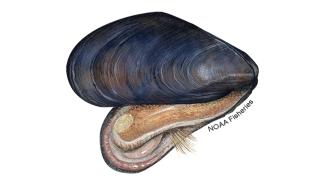
Identification:
Blue Mussels (Mytilus edulis) has a smooth shell which is roughly shaped like an elongated triangle, with the beak forming the apex. The anterior margin is straight, while the posterior margin is broadly rounded. The surface is marked by concentric growth lines with the exterior being black to bluish black, or brown, while the interior is white with a violet margin. The shell can reach a length of 100 mm. Like other mussels, the blue mussel commonly clings to hard surfaces by a cluster of byssus threads.
Habitat:
Blue mussels have long been treated as a single species, naturally distributed through the temperate regions of the Northern and Southern Hemispheres. Blue mussels are currently defined as native to the North Atlantic from Newfoundland, Iceland, northern Norway, and the White Sea, south to Cape Hatteras, North Carolina and the Bay of Biscay, at the French-Spanish border. Blue mussels are characteristic of the shallow subtidal and intertidal zone and can be subject to sharp changes in temperature when exposed to the air, and changes in salinity due to rainfall and river flow.
Species Info:
In its native range, the blue mussel is seen as both economically and ecologically important as an ecosystem engineer, a major component of coastal foods webs, and an important food source. Blue mussels are suspension feeders, feeding on phytoplankton and detritus.
Blue mussels have become extensively cultured in open waters and in aquaculture.
- Farmers will collect larval mussels (spat) from wild populations
- Mature mussels grow-out:
- On-bottom – mussels are seeded on sea bottom to form beds
- Off-bottom – mussels are grown in the water column using longline (rope), raft or bouchot methods (on ropes wrapped around marine pilings or poles).
Regulations & Management:
The primary federal agency overseeing blue mussels is the National Marine Fisheries Service (NMFS) under the Magnuson-Stevens Act (MSA). In New England, the New England Fishery Management Council (NCFMC) oversees blue mussel regulations in New England waters. At the state level, the Rhode Island Department of Environmental Management (RIDEM) manages the management of blue mussels in Rhode Island. Blue mussels are a popular species for shellfish aquaculture. Permitting for shellfish aquaculture is governed by federal, state, and local governments.
- Federal agencies include NOAA, the Army Corps of Engineers, U.S. Fish and Wildlife Service, U.S. Department of Agriculture, the Environmental Protection Agency, the Food and Drug Administration, the Bureau of Ocean Energy Management, and the Coast Guard.
- All fisheries and aquaculture farms in federal waters must adhere to federal regulations including those in the Magnuson-Stevens Fishery Conversation and Management Act, the Endangered Species Act, the National Environmental Policy Act, the Clean Water Act, and the Marine Mammal Protection Act.
According to NOAA, U.S. farmed blue mussels are considered a smart seafood choice because they are sustainably grown and harvested under U.S. state and federal regulations. Here’s where to find local growing areas, and where to buy locally harvested blue mussels
Rhode Island Minimum Size & Possession limits can be found here: Marine Fisheries Minimum Sizes & Possession Limits | Rhode Island Department of Environmental Management
Sources:

Identification:
The easter oyster Crassostrea virginica has smooth edges and is oval with “cupped” shape, giving rise to its alternative name “American cupped oyster”. The inside of the shell is white to off white to brownish in color.
Habitat:
Eastern oysters are found along eastern North America from the Gulf of St. Lawrence to the Gulf of America (formerly Gulf of Mexico). They are found in the middle and lower Chesapeake Bay and its rivers. They are the only species of oyster native to this region.
Eastern oysters live in brackish and salty waters from 8 to 35 feet deep. In some warmer areas, they are able to live in the intertidal zone. They attach to firm bottoms areas, and to each other, to grow into reefs. These reefs provide habitat for fish, crabs, invertebrates, macrofauna, and birds.
Species Info:
The eastern oyster is a treasured food by humans and other species. They are habitat for many species including fish, crabs, and other aquatic life. Since eastern oysters are filter feeders, they help to filter water and improve water quality. Centuries ago, they were plentiful with some reefs being so big, that ships had to navigate around them. Since then, the population has drastically decreased due to disease, overharvesting, habitat loss, and poor water quality.
Buy many people and agencies including NOAA, are working hard to rebuild oyster populations. Oyster aquaculture has become very popular and is a growing industry. NOAA and its partners are working to restore healthy oyster reefs to improve oyster populations and give many other species the habitat they rely on.
Regulations & Management:
Eastern oysters are managed both federally, state, and locally under regulations to protect ecosystems and ensure shellfish are safe for human consumption. The primary federal agency responsible for regulation and management in the U.S. is the Food and Drug Administration (FDA), which enforces the National Shellfish Sanitation Program (NSSP) under the Federal Food, Drug, and Cosmetic Act and Public Health Service Act.
In Rhode Island, the Department of Environmental Management, division of Marine Fisheries (RIDEM DMF) oversees all state regulations regarding the eastern oyster. Regulations regarding eastern oysters are codified under the Marine Fisheries Statues and Regulations (Title 250, Chapter XXX, Part VIII – Oyster Regulations). Eastern oysters make up nearly all of Rhode Island's oyster production, with most being grown in Narragansett Bay and salt ponds.
RIDEM and the Natural Resources Conservation Service (NRCS), with support from Coastal Resources Management Council (CRMC) have developed the NRCS EQIP Oyster Restoration program with the goal of restoring oyster reefs in protected waterbodies across Rhode Island to try and increase oyster populations (RI estimates show only about 1% of historic levels once found in local waters.)
Rhode Island Minimum Size & Possession limits can be found here: Marine Fisheries Minimum Sizes & Possession Limits | Rhode Island Department of Environmental Management
See our latest Annual Fisheries Report for details about recent harvests.
Sources:
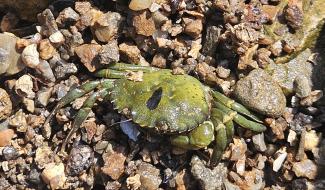
Identification:
Green crabs (Carcinus maenas) have a highly variable color, but adults are typically multicolored with a dorsal surface ranging from dark green, grayish green, or reddish, while the undersurface is yellowish white to orange. In juveniles, the color is highly variable as well, often with bold contrasting colors. Green crabs have a broad abdomen with claws that are slightly unequal, and nearly smooth expect for two ridges on the upper surface of the hand.
Habitat:
The green crab is native to European coasts from Iceland and Norway to Mauritania, West Africa. It has been listed as one of the 100 worst invasive species and has invaded 6 major regions including the Northwest Atlantic (from Maryland-Newfoundland), the Southwest Atlantic (Patagonia), the Southeast Atlantic (South Africa), the Northeast Pacific(from California-Alaska), the Northwest Pacific (Japan), and the Southwest Pacific (Australia).
Green crabs are most abundant in intertidal and shallow subtidal habitats through most of its range. It is more abundant in shallow, protected bays on exposed shores.
Species Info:
Green crabs have had a major economic impact on shellfisheries in New England. Ecologically, green crabs have impacted shore communities by preying on, competing with, other crabs, bivalves and gastropods. Green crabs are omnivorous, but their diet tends to be dominated by invertebrates, especially mollusks, crustaceans, and annelids. Algae is also a common component of their diet.
Due to green crabs predation on shellfish, shell fisherman use mesh bags, cultivation on ropes and in cages to minimize predation, and may use traps to remove crabs to prevent losses to shellfish.
The invasion of green crabs has even caused for some evolutionary changes in some prey populations. In the Gulf of Maine, several species of gastropods have seen changes in shell morphology which makes their shells more resistant to crushing to help prevent predation by green crabs.
Regulations & Management:
Due to green crabs being an extremely invasive species, the regulations and management of the species differ from many others. Green crab management combines prevention, early detection, monitoring, and localized suppression, guided by formal plans and regulatory frameworks. The primary agency involved in green crab regulations is the U.S. Fish and Wildlife Service (FWS), through the Aquatic Nuisance Species Task Force, with support from NOAA Fisheries, state agencies, and tribal partners.
The European Green Crab Management Plan (2023), developed by the Aquatic Nuisance Species Task Force and U.S. FWS sets four core goals to help regulate green crabs:
- Prevention: Minimize future introductions through port health measures, trade controls, and public awareness
- Monitoring: Support early detection via standardized surveys, trapping, and environmental DNA (eDNA) sampling
- Rapid Response: coordinate management actions when new invasions are detected.
- Research & Education: Fund science, outreach, and stakeholder engagement
For Rhode Island, management is overseen by Rhode Island Department of Environmental Management (RIDEM) and follows the federal plan’s framework with enforcement and local monitoring.
Sources:

Jellies include cnidarians and ctenophores. Both are gelatinous marine animals but they belong to different phyla, meaning they are not closely related. They may all have gelatinous bodies, but these groups move and feed differently. For example, cnidarians contain stinging cells called cnidocytes, while ctenophores do not sting. Here are a few of the species you may encounter in Rhode Island. More information is available in our Learn about Jellies PDF linked at the top of this webpage under Educational Materials and Coloring Books.
- Cnidarians
- True Jellies
- Sea Nettle and Atlantic Bay Nettle (Chrysaora quinquecirrha and Chrysaora chesapeakei)
- Lion's Mane (Cyanea capillata)
- Mauve Stinger (Pelagia noctiluca)
- Moon Jellyfish (Aurelia aurita)
- Siphonophores
- Portuguese Man O' War (Physalia physalis)
- True Jellies
- Ctenophores
- Northern Comb Jelly (Bolinopsis infundibulum)
- Sea Walnut (Mnemiopsis leidyi)
- Sea Gooseberry (Pleurobrachia pileus)
- Other - tunicates are sometimes mistaken for jellies due to their transparent appearance
- Salps

Identification:
The Jonah crab (Cancer borealis) was historically bycatch in the American lobster fishery, but since has become a targeted species and has steadily gained landings since the early 2010s. Jonah crabs are characterized by a round, reddish-brown shell with rough-edged teeth and small yellow spots. They can be identified by their large claws which have dark brown/black tips.
Habitat:
Jonah crabs are generally found from intertidal zones down to depths of 2600 feet. Their habitat ranges from rocky substrates in coastal and offshore areas to softer, silt and clay bottoms along the continental slope.
They can be found in Northwest Atlantic, ranging from Canada to Florida. In the U.S., there is a commercial Jonah fishery that spans from Maine through Virginia. But most are caught by fishermen on the outer continental shelf south of Massachusetts and Rhode Island.
Species Info:
The life cycle of Jonah crabs is poorly understood. While little is known about their movements, it is widely believed females migrate in the spring to shallower waters and return offshore to deeper, colder waters during the fall and winter.
Jonah crabs are omnivorous and consume a variety of species, including snails, mussels, urchins, algae, and arthropods.
Regulations & Management:
Jonah crabs are co-managed by NOAA Fisheries and the coastal states through the Atlantic States Marine Fisheries Commission (ASMFC). The American Lobster Management Board within the ASMFC oversees both American lobster and Jonah crab. Recommend measures are implemented by states in state waters and by NOAA Fisheries in federal waters under the Atlantic Coastal Fisheries Cooperative Management Act (Atlantic Coastal Act).
See our latest Annual Fisheries Report for details about recent harvest.
Sources:

Identification:
The longfin inshore squid (Doryteuthis (Amerigo) pealeii) is sometimes called loligo squid due to an older scientific name. Loligo is now Doryteuthis. Longfin squid have an internal shell called a “pen”. Their fins are long, at least half the length of the mantle (large part of the squid in front of the head). The head has large eyes that covered by a cornea. They are likely color bind but are able to use special pigment cells in their skin (called chromatophores) to change their color and patterns to escape predators or disguise themselves from prey. They are typically pink or orange and mottled with brown or purple.
Habitat:
Adults live over mud or sand/mud substrates of the continental shelf and upper continental slope in waters as deep as 1300 feet. Adults and juveniles migrate vertically in the water column, remaining near the seabed during the day and moving toward the surface at night. Paralarvae are found in surface waters. Juveniles also live in the upper water column in water 165 or 1650 feet deep.
Longfin squid are found from Newfoundland to the Gulf of Venezuela. In the Northwest Atlantic Ocean, longfin squid are most abundant between Georges Bank and Cape Hatteras, North Carolina.
Species Info:
Longfin squid is one of Rhode Island highest value species by landings (volume and value). The majority of longfin squid landings come from Rhode Island, New York, New Jersey, and Massachusetts.
Longfin squid grow fast and have short life spans. They are aggressive hunters and will consume fish larger than themselves and will eat their own species. They are a key prey species for a variety of marine mammals, diving birds, and finfish species.
Regulations & Management:
NOAA Fisheries and the Mid-Atlantic Fishery Management Council manage the longfin squid fishery. The fishery is managed under the Atlantic Mackerel, Squid, and Butterfish Fishery Management Plan.
The plan entails:
- Fisherman with a limited access permit can fish for unlimited amounts of longfin squid while the fishery is open. All other fishermen must obtain an incidental catch permit and have possession limits.
- An annual coastwide catch quota is divided into trimester allocations. Managers monitor annual quotas closely, as there can be large fluctuations in abundance from year to year.
- Managers set a cap on the number of butterfish that can incidentally caught in the longfin squid fishery to help prevent overfishing on the butterfish stock.
In 2024, commercial landings in Rhode Island totaled over 19 million pounds, valued at over $19 million, according to the NOAA Fisheries commercial fishing landings database.
Buy locally caught longfin squid! According to NOAA, longfin squid is a “smart seafood choice” thanks to sustainable management and responsible harvest. Here’s where to find what’s being caught by fishermen, and where buy locally caught longfin squid:
See our latest Annual Fisheries Report for details about recent harvest.
Sources:
Squilla empusa

Identification:
The ocean quahog (Arctica islandica) is divided into two main regions for the U.S. fishery, Maine and Long Island, New York. Ocean quahogs are bivalve mollusks; they have two hinged shells that enclose their body. Their shells are thick and oval-shaped with the outside being a dull gray with growth rings that can be used to determine its age. The interior of their shell is white with a purple border.
Habitat:
Ocean quahogs are found in the western Atlantic as far south as Cape Hatteras, North Carolina.
Ocean quahogs live in water between 25 and 1300 feet deep. In the northern part of their range, they’re found in shallower water closer to shore. The U.S. stock is almost entirely within federal waters (3 to 200 nautical miles from shore), except for a modest amount off the coast of Maine and in waters between 65 and 260 feet deep. Ocean quahogs are rarely found where bottom water temperatures exceed 60° F. Ocean quahogs burrow in a variety of sediments, especially fine sand.
Species Info:
Ocean quahogs are filter feeds. They bury themselves in the ocean floor and pump oxygen-filled water and food particles in through their siphons, which extend above the surface of the ocean floor. Ocean quahogs are among the longest-lived marine organisms in the world. Off the U.S. East Coast, where the fishery takes place, ocean quahogs can live for at least 200 years. Many species prey on juvenile ocean quahogs but once they reach a certain size, they have a very low predation rate.
Ocean quahogs are generally fished for human consumption in soups, chowders, and stews; while a small portion of landings are sold in the bait market.
Regulations & Management:
NOAA Fisheries, the Mid-Atlantic Fishery Management Council, and state resource management agencies manage the ocean quahog fishery. The fishery is managed under the Surfclam-Ocean Quahog Fishery Management Plan.
The plan entails:
- Fishermen must have a permit for commercial harvest ocean quahogs.
- Individual transferable quota (catch shares) program – managers set an annual catch limit for federal waters and allocate it among individual fishermen or vessel owners. These individual quotas can be sold or leased.
- Closed areas due to environmental degradation or to toxins that cause paralytic shellfish poisoning (PSP).
- Fisherman harvesting ocean quahogs from Georges Bank have additional requirements under the PSP testing protocol.
- Mandatory vessel monitoring systems.
- Fisherman must maintain and submit logbooks of each fishing trip to document catch.
The ocean quahog fishery off Maine is managed separately because of differences in biological, fishery, and market characteristics.
In 2023, the ocean quahog fishery produced 12.4 million pounds of meats, valued at $8.3 million, according to the NOAA Fisheries commercial fishing landings database. (2024 data is confidential due to limited number of participants).
According to NOAA, U.S. wild-caught ocean quahog is a smart seafood choice because it is sustainably managed and responsibly harvested under U.S. regulations.
See our latest Annual Fisheries Report to see recent harvests.
Sources:
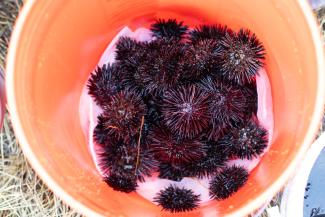
Identification:
The purple sea urchin (Arbacia punctulata), like all sea urchins, are known as the porcupines of the sea. They have long spines in order to deter predators. Their body, called a test, is made up of ten fused plates that encircle the urchin. Each of these fused plates has small holes from which the feet extend. Sea urchins also have a unique structure called Aristotle’s lantern. This structure is made of five hard plates that move together like a beak. They use this beak like structure to scrape rocks clean of algae. These ‘teeth’ can also grow back after too much wear.
Habitat:
Purple sea urchins are a common urchin from Cape Cod to the West Indies. They are found most commonly on rocks and shells in somewhat deep salt water. They prefer to live on rocks or shell bottoms from the low-tide line to a water depth of about 750 feet.
Species Info:
Purple sea urchins are able to regrow broken spines and have been observed to even dig their own holes and wear away at the rocks until they are ‘comfortable’, residing in that hole until the current changes or they move. Sea urchins are typically harvested for food and for their shells. Their eggs are a delicacy in many countries. They are also commonly used as a laboratory species for studying reproduction and development. Rhode Island also has green sea urchins (Strongylocentrotus droibaciensis), but they are less common and generally found further offshore.
Regulations & Management:
In Rhode Island, there are currently no significant commercial fishery or dedicated management program for purple sea urchins. Despite there being no significant commercial fishery for sea urchins, there is interest focused on aquaculture and ecological applications. For example, at the University of Rhode Island, Dr. Coleen Suckling is researching a way to integrate sea urchins with salmon and kelp to reduce aquaculture’s environmental footprint and develop specialized feeds for sea urchin farming.
Management of purple sea urchins is primarily managed by Rhode Island Department of Environmental Management, Division of Marine Fisheries (RIDEM DMF). RIDEM DMF is responsible for managing marine resources, fisheries regulations, habitat protection, and marine species monitoring. For activities involving aquaculture, regulatory authority is shared by Rhode Island Coastal Resources Management Council (CRMC). RIDEM handles licensing and marine resource management while CRMC is the lead agency for aquaculture permitting in Rhode Island waters.
Sources:

Identification:
The quahog (Mercenaria mercenaria) is Rhode Island’s official shellfish. They are a species of hard-shelled clam. Their shell is thick, grey to white in color, and has outer concentric growth rings. The inside of the shell is white with violet markings. Some hatchery raised clams have dark, zigzag stripes across the shell known as “notata”.
Habitat:
Quahogs prefer sandy or fine gravelly substrates mixed with mud (soft enough to burrow but firm enough to remain stable). They typically inhabit intertidal and subtidal zones, from shallow tidal flats down to about 20 – 30 feet deep.
Quahogs are found along the Atlantic coast of North America, from Nova Scotia, Canada, to Florida. They are most abundant in the northeastern United States, particularly in Massachusetts, Rhode Island, New Jersey, and Long Island, New York.
Northern waters, like Maine, produce smaller, sweeter clams, while southern waters, such as Virginia and North Carolina, support larger specimens.
Species Info:
Adult clams are sessile and stay in one place, in both intertidal and subtidal areas. Clams burrow into the sediment, leaving only their siphons exposed to feed. Hard clams prefer saline water and cannot survive if the salt content is too low.
The popular animated sitcom Family Guy takes place in a fictional town called “Quahog” that is depicted as a town in Newport County, Rhode Island, modeled after Cranston. Despite being portrayed in the show, Quahog is not a real city in Rhode Island.
Regulations & Management:
Permitting for shellfish aquaculture is governed by federal, state, and local governments. In the U.S., the primary federal agency that manages and regulates the quahog fishery and aquaculture is NOAA Fisheries, with support from Rhode Island Department of Environmental Management, Division of Marine Fisheries (RIDEM DMF). NOAA Fisheries implements regulations under the Magnuson – Stevens Fishery Conservation and Management Act and provides science-based management for both wild and farmed quahogs.
Other agencies can also get involved in related oversight regarding Quahogs including:
- U.S. Environmental Protection Agency (EPA): water quality and habitat protection
- U.S. Department of Agriculture (USDA): Aquaculture research and support programs
- Atlantic States Marine Fisheries Commission (ASMFC): Regional cooperation for shellfish conservation
Buy locally caught Quahogs! According to NOAA, quahogs are a “smart seafood choice” thanks to sustainable management and responsible harvest. Here’s where to find what’s being caught by fishermen, and where buy locally caught quahogs:
Rhode Island Minimum Size & Possession limits can be found here: Marine Fisheries Minimum Sizes & Possession Limits | Rhode Island Department of Environmental Management
See our latest Annual Fisheries Report for details about recent harvest.
Sources:

Identification:
The sea scallop (Placopecten magellanicus) is a bivalves like clams and oysters. The shells are held together by the adductor muscle (the part of the scallop typically eaten). Sea scallops have a saucer-shaped shell with scalloped or fluted edges. The upper shell is usually a reddish-pink or brown in color with the lower shell being white or cream. A small percentage of sea scallops are albinos (5 – 10 percent) with the upper and lower shells being white. Sea scallops are smooth and lack the prominent ribbing that is characteristic of most other scallop shells. This is thought to be an adaptation to allow it to propel itself faster and farther.
Habitat:
Atlantic sea scallops are found in Northwest Atlantic Ocean, from Newfoundland to Cape Hatteras, North Carolina. Adult scallops live close together in groups called “beds” on sandy or gravelly parts of the ocean floor. They are generally found at depths of 100 to 300 feet on Georges Bank and in the Mid-Atlantic. They can also be found in shallower waters in Maine and Canada.
Species Info:
Sea scallops can live up to 20 years and grow quickly for the first few years of their lives. Sea scallops are very fertile, with a female sea scallop able to produce hundreds of millions of eggs per year. For this reason, scallops may respond more rapidly to management actions than species that reproduce slowly and in small numbers.
Regulations & Management:
NOAA Fisheries and the New England Fishery Management Council manage the Atlantic Sea scallop fishery. The fishery is managed under the Atlantic Sea Scallop Fishery Management Plan.
- Managers determine a total allowable catch for the scallop fishery based on estimates of the scallop population. They allocate this catch amount to different groups of the fishery, depending on their permit type and historical catch, through days-at-sea and number of trips to special access areas.
- Other management measures include:
- Limits on crew size.
- Areas closed to scallop dredging to allow young scallops to grow large and reproduce, and to reduce bycatch of non-targeted species.
- Vessels harvesting scallops must use vessel monitoring systems (a satellite communications system used to monitor fishing activities).
- Individual Fishing Quotas (IFQs), a type of catch share program, for Limited Access General Category permit holders.
In 2023, commercial landings of Atlantic Sea scallop totaled 27.4 million pounds of sea scallop meats and were valued at $360 million, according to the NOAA Fisheries commercial fishing landings database. The U.S. Sea scallop fishery is extremely important to the U.S. economy and is the largest wild scallop in the world.
Rhode Island Minimum Size & Possession limits can be found here: Marine Fisheries Minimum Sizes & Possession Limits | Rhode Island Department of Environmental Management
See our latest Annual Fisheries Report for details about recent harvest.
Sources:
Crepidula fornicata
Identification:
The soft-shell clam (Mya arenaria) is commonly known by a number of names including soft-shell clam, gaper, steamer, longneck, and nanny-nose. Soft-shell clams are bivalves with a thin, elongated, elliptical shell, gaping at the anterior and posterior ends even when closed. The shell is chalky white with a thin dull-brown or yellowish. Typically, it will burrow in soft, muddy to sandy sediments in shallow waters and intertidal mud flats.
Habitat:
Soft-shell clams can be found along the eastern coast of North America, from Canada to the southern United States, and is also found in the Eastern Atlantic Ocean, including the UK and the North Sea. The species typically inhabit gravelly to muddy bottoms, from the mid-intertidal to about 100 m depth, though they are rare below 9-10 m. In regions with large tidal ranges, they are most abundant in intertidal mudflats. Soft-shell clams typically prefer low salinities as well (4-5 PSU).
Species Info:
Soft-shelled clams are an important shellfish species in its native range, from Atlantic Canada to Chesapeake Bay, supporting both commercial and recreational fisheries. Softshell clams are suspension feeders and are able to feed in water with considerable quantities of suspended silt and are able to sort cells for silt particles before ingestion. Small clams are typically eaten by fish, crabs, clam worms, moon snails, and birds. Mortality is very high for larvae and seed clams, but once the clams reach adult size, a life span of 10 years is typical, with some specimens living for 20 years.
Regulations & Management:
Since softshell clams are mainly harvested near shore, state agencies mainly regulate and manage softshell clams. Rhode Island Department of Environmental Management, Division of Marine Fisheries (RIDEM DMF) is responsible for regulation and management which includes:
- Establishing harvesting regulations (size limits, possession limits, gear restrictions, and licensing requirements)
- Licensing and Permitting (commercial shellfish licenses, multipurpose fishing licenses with shellfish endorsements)
- Shellfish Area Classification and Closures
- Monitors water quality
- Tests for bacterial contamination and pollution
- Classifies shellfish-growing waters
- Opens and closes harvesting areas when necessary
- Population monitoring and assessment
- Habitat Protection
- Enforcement
- Public Health Protection
Sources:

Identification:
Surf clam (Spisula solidissima) are the largest bivalves found in the western North Atlantic. They can grow up to 8.9 inches, although clams larger than 7.9 inches are rare. Their shells are thick, triangular, and yellowish white with rounded edges and concentric ridges. Shells do not close fully and gape slightly.
Habitat:
Juveniles burrow in medium-to fine-grain sand in waters 30 to 80 feet deep. Adults prefer medium- to coarse-grain sand and gravel from beach zones to over 160 feet deep. Adult surf clams prefer more turbulent waters and bury themselves just below the sediment surface. They are found in the western North Atlantic from the southern Gulf of St. Lawrence to Cape Hatteras, North Carolina. They’re most abundant on Georges Bank, the south shore of Long Island, New Jersey, and the Delmarva Peninsula.
Species Info:
Surf clam shells are often found along the beaches of the South Shore of Rhode Island. Surf clams can live up to 35 years, with surf clams living in open water typically living longer than those living inshore. Surf clams grow fast with growth rates depending on water temperature. Surf clams are generally processed for human consumption in soups, chowders, and stews; while a small portion of landings are also sold in the bait market.
Regulations & Management:
NOAA Fisheries, the Mid-Atlantic Fishery Management Council, and state management agencies manage the surf clam fishery. The fishery is managed under the Surfclam-Ocean Quahog Fishery Management Plan. Fisheries closer to shore are managed by state authorities (within 3 miles of shore).
In 2024, commercial landings of surf clams totaled 21 million pounds and were valued at approximately $27 million, according to the NOAA Fisheries commercial fishing landings database. Surf clams are the most important commercial clam species harvested in the U.S.
The surf clam fishery is managed under an individual transferable quota program that provides fishermen with more flexibility on when to fish, slows the pace of the fishery, and increases its efficiency, significantly reducing bycatch.
Rhode Island Department of Environmental Management, Division of Marine Fisheries (RIDEM DMF) applies all regulations for harvesting surf clams in Rhode Island waters which includes:
- Harvest Regulations
- Licensing and Reporting
- Enforcement
- Habitat and Environmental Oversight
Rhode Island Minimum Size & Possession limits can be found here: Marine Fisheries Minimum Sizes & Possession Limits | Rhode Island Department of Environmental Management
Sources:

Identification:
- Knobbed whelk - Busycon carica
- The spiral shell of the knobbed whelk has low spines on its shoulder, and the shell opening is located on the right side. The shell color varies: the outer shell ranges from grayish white to tan, while the inner shell ranges from pale yellow to orange. A hard plate called the operculum act like a trap door when the snail retracts into its shell. The body of the snail is divided into head, abdomen and foot. Two pairs of tentacles are located on its head: one senses light, while the other is used for touch and smell.
- Channeled whelk - Busycotypus canaliculatus
- Channeled whelks are pear-shaped with a large body whorl and a straight siphonal canal. A wide, deep channel runs between the whorls along the suture, giving the shell a stepped or pagoda-like appearance. Fine growth lines spiral around the shell, and the surface is often gray to light tan. The outer shell may be grayish to olive with a felt-like texture.
Habitat:
Both whelks are marine gastropods that live in shallow, nearshore, benthic environments along the North Atlantic coast from southern Massachusetts to Florida. Both species are found in sandy, muddy, or mixed sediment bottoms in intertidal and subtidal zones. They occupy oyster beds, mudflats, and sand flats from the low tide line down to depths of about 15 meters. Whelks prefer shallow, well oxygenated waters that are nutrient rich and sheltered.
Species Info:
Whelks are predatory scavengers that feed on bivalves such as clams and mussels, using their strong muscular foot and radula to pry shells open. They burrow into the sediment during winter or low activity periods, reducing feeding and growth. Whelks tend to be more active during the day.
Regulations & Management:
In Rhode Island, both channeled and knobbed whelk are regulated and managed by Rhode Island Department of Environmental Management, Division of Marine Fisheries (RIDEM DMF). RIDEM DMF manages whelks through several regulations:
- Harvest regulations
- Commercial fishery management
- Conservation measures
- Enforcement
- Habitat protection
Unlike other species, there is no federal fishery management plan specifically for channeled and knobbed whelk. The management of the species is largely conducted by individual states, with interstate coordination occurs through the Atlantic States Marine Fisheries Commission (ASMFC), which has developed management guidance and conservation measures.
See our latest Annual Fisheries Report for details about recent harvest.
Sources:
Seaweed
Rhode Island is home to a plethora of seaweeds. Here we highlight just a few species of interest, mostly because they provide valuable habitat to marine fish and invertebrates. For a more detailed look at marine plants and macroalgae, see this guide.
Most people are not aware that seaweed includes both marine plants and algae (which are not plants, but rather protists). Marine algaes have no true roots, leaves, stems or vascular systems.
Additional resources can be found through the Rhode Island Macroalgae Working Group.
Identification:
Eelgrass (Zostera marina) is a species of vascular submerged aquatic vegetation that roots in soils of shallow coastal waters. Eelgrass is a true plant, having roots and rhizomes (underground stems) and it produces flowers and seeds. These plants have long flat blade like leaves that attach at a common base and can have varying morphology depending on environmental factors. Eelgrass reproduces asexually through rhizomes and sexually by seed production and dispersal, typically occurring through the summer in Rhode Island.
Habitat and Species Info:
Eelgrass is found along temperate latitudes across the Northern Hemisphere on the Pacific and Atlantic coast, and on coasts of Eurasia. On the Atlantic Coast, it can be found from Maine to North Carolina. Zostera marina is found in shallow sheltered tidal estuaries, bays, and lagoons with high salinity conditions. Eelgrass beds are highly productive ecosystems that serve as habitat, shelter, and food source for economically important fish species. It is also an important nursery habitat for many fish and invertebrate species. Eelgrass beds also provide other ecosystem services such as buffering wave energy and protecting shorelines, storing blue carbon and improving water quality.
Management:
Eelgrass is managed both federally and statewide. This species is designated as essential fish habitat under the Magnuson-Stevens Act and is protected under the Clean Water Act section 404(b)(1). NOAA Fisheries works to conserve eelgrass through development of policy which aims to minimize and offset impacts onto this habitat. At the state level, RI CRMC and RI DEM aim to protect, manage, monitor and restore the species and its population. CRMC Section 300.18 of the RI Coastal Resources Management Program (RICRMP) provides the regulations for Submerged Aquatic Vegetation.
Other Resources:

Bladderwrack (Fucus vesiculosus and/or Fucus distichus) - brown algae
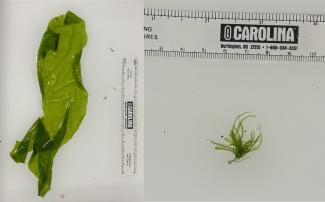
Sea lettuce (Ulva lactuca), blade and tubular form - green algae

Irish moss (Chondrus crispus) - red algae

Sugar kelp (Saccharina latissima) - brown algae

Siphoned feather weed (Dasysiphonia japonica) - INVASIVE, red algae

Dead man’s fingers (Codium fragile) - INVASIVE, green algae

Devil’s tongue weed (Grateloupia turuturu) - INVASIVE, red algae

Rockweed (Aschophyllum nodosum) - brown algae

Sea cauliflower (Leathesia marina) - brown algae
There are three main groups of macroalgae:
- Red Algae (Rhodophyta)
- Red algae own their color to phycoerythrin and phycocyanin, pigments that enable them to absorb light in deeper waters. They are highly diverse and can inhabit intertidal zones to significant ocean depths. Red algae are important for ecosystem structure, food sources, and human uses such as agar and carrageenan production.
- Brown Algae (Phaeophyta)
- Range from olive green to dark brown due to accessory pigment fucoxanthin, which allows them to absorb blue-green light and thrive at greater depths. This group of macroalgae contains some of the largest and most complex seaweeds. Brown algae form underwater forests that provide shelter and nursery habitats for marine life and contribute significantly to nutrient cycling.
- Green Algae (Chlorophyta)
- Contains chlorophyll a and b, giving them a bright green color similar to terrestrial plants. They store energy as starch and are typically found in shallow, well-lit waters because their pigments absorb red and blue light efficiently. Green algae play a role as primary producers and provide food and habitat for various marine organisms.
Identification by species:
- Bladderwrack (Fucus vesiculosus and Fucus distichus)
- Bladder wrack is an olive-brown ‘wrack’ seaweed. It can be recognized by its strap-like, branching fronds that have air-filled ‘bladders’ along their length (often appearing in pairs either side of the pronounced mid-rib). The edges are not serrated.
- Coccotylus truncatus
- Coccotylus truncatus has a red coloration due to phycoerythrin and phycocyanin pigments masking chlorophyll-a and other pigments. The thallus is typically robust, with a truncated or cut off leaf structure. The algae can form dense mats in coastal habitats, contributing to the structural complexity of benthic ecosystems.
- Coral weed (Corallina officinalis)
- Coral weed is a hardy red seaweed. It has a delicate, branching fronds and distinctive red hue tipped in white, this calcareous alga resembles miniature coral.
- Dead man’s fingers (Codium fragile) - INVASIVE
- Codium fragile is a green alga with thick, spongy, finger-like fronds that can grow up to 1 meter long. Its branches are dichotomously forked, cylindrical, and covered with densely packed, short hairs, giving a felt-like slimy texture. The fronds hang from rocks at low tide, which inspired the common name “Dead Man’s Fingers”. Older branches are dark green, while new growth is bright green, and dead branches appear whitish yellow. Dead man’s finger is not native to the east coast and is invasive. Its native range is the Pacific near Japan.
- Devil’s tongue weed (Grateloupia turuturu) - INVASIVE
- Devils tongue weed is a large red seaweed with a deep red to purple in color, sometimes bleaching to light brown in summer. One to six elongated, lance-shaped blades up to 15 cm in width and 1 m in length arise from a disc holdfast via a short stipe. The plant is thick and firm with a mucilaginous texture which is slippery to touch. Devil’s tongue weed is invasive on the east coast. Its native range is the northwest Pacific.
- Gracilaria tikvahiae
- A species of red algae that is known for its economic importance and ecological adaptability. Gracilaria tikvahiae typically features finely branched clumps that can grow up to 1 meter in length. The thalli are cylindrical and may vary in color from green to red, depending on environmental conditions.
- Horsetail kelp (Laminaria digitata)
- Horsetail kelp is a dark brown, nutrient-rich seaweed found in cold, turbulent coastal waters, valued for both ecological and culinary uses. It has sturdy, finger-like blades and a short, thick stipe that can be as thick as a human thumb. Horsetail kelp often forms dense beds that provide habitat and nutrients for marine life, contributing to the structure of kelp forests.
- Irish moss (Chondrus crispus)
- Irish moss is a red alga that typically forms dense tufts with flat, fan-shaped fronds that range in color from greenish yellow to deep red or purple and grow up to 20 – 30 cm in length. The fronds are broadly branched, cartilaginous, and firm, often showing violet or blue iridescence underwater.
- Rockweed (Aschophyllum nodosum)
- Rockweed has long, tough, and leathery fronds, irregularly dichotomously branched fronds with large, egg-shaped air bladders set at regular intervals along the fronds and not stalked.
- Sea cauliflower (Leathesia marina)
- Sea cauliflower is a brown alga that is solid and globular when young. As it matures, it becomes hollow, thick walled, and deeply convoluted, resembling a leathery bag or brain-like cushion. Mature individuals are yellowish-brown. The texture is rubbery with a smooth outer surface.
- Sea lettuce (Ulva lactuca)
- Sea lettuce is a widely distributed edible green alga with thin, translucent, ruffled fronds, rich in vitamins and minerals. It is commonly used in salads, soups, and health products. The leaves are often broad, ruffled, lobed, or perforated, giving it “windowed” appearance. Its color ranges from light green in young plants to dark green in mature individuals.
- Sea potato / oyster thief (Colpomenia peregrina) - INVASIVE
- The sea potato is a small brown alga, bladder-like, hollow and membranous. The surface is thin and smooth but often collapsed or torn when older. It's typically brown in color and attached by filaments to rocks at the base. The sea potato is native to the north Pacific. It is invasive in Europe, the Mediterranean, the Black Seas, and the Northwest Atlantic.
- Siphoned feather weed (Dasysiphonia japonica) - INVASIVE
- Siphoned feather weed is a red filamentous seaweed with bushy fronds. It grows both drifting in masses or attached to a substrate. Positive identification for the species requires a microscope. The species is native to the Northwest Pacific. The species is invasive in the Northeast Atlantic, Mediterranean Sea, and the Northwest Atlantic, where the species was first reported in 2007 in Narragansett Bay, Rhode Island.
- Skinny kelp (Saccharina angustissima)
- Skinny kelp is a variety of sugar kelp characterized by long, thin, strap-like blades that adapt it to high-energy, open-ocean environments. The blades of skinny kelp are significantly longer and narrower than pure sugar kelp; in crosses with sugar kelp, offspring show even greater length and narrowness.
- Sugar kelp (Saccharina latissima)
- Sugar kelp is a brown seaweed known for its nutritional value, culinary versatility, ecological importance, and natural sweetening properties. Sugar kelps are yellowish or dark-brown and green in color. They resemble large lasagna noodles and have a long narrow, undivided blade with a short thin stem. The central band of the blade is dimpled while the margins are smoother with a wavy edge. The crinkled blade gives the sugar kelp its other common names (Sea belt, Devil’s apron)
Management:
In the U.S. the National Oceanic and Atmospheric Administration (NOAA) is the primary federal agency responsible for regulating and managing the harvesting of macroalgae through marine aquaculture and wild harvest. NOAA’s role is defined under the National Aquaculture Act of 1980, which established the Subcommittee on Aquaculture (SCA) as the federal interagency coordinating body for aquaculture programs. The SCA, which includes NOAA as the lead agency oversees assistance for aquaculture, including seaweed farming. For commercial aquaculture, NOAA issues the primary federal permits required to operate. In many cases, state agencies will collaborate with federal agencies to regulate macroalgae.
In Rhode Island, the Department of Environmental Management (RIDEM) and the Coastal Resources Management Council (CRMC) regulate marine aquaculture, including macroalgae. Permits are required for commercial or experimental aquaculture, and regulations cover site selection, handling, tagging, and temperature control of cultured species. Other state programs like the Narragansett Bay Estuary Program (NBEP) assists in macroalgae management. NBEP assists with monitoring and research to assess growth patterns, habitat impacts, and interactions with shellfisheries.
Management goals include:
- Preventing harm to shellfisheries
- Controlling nutrient loads
- Supporting sustainable aquaculture
- Monitoring and adapting to changes
Identification:
Widgeon Grass (Ruppia cirrhosa) is a species of vascular submerged aquatic vegetation that grows in brackish to saline waters. The flowers are small and white, and the fruits are roundish, dark and 2 – 3 mm long.
Habitat and Species Info:
Widgeon grass is a true plant, having roots and rhizomes (underground stems); it produces flowers and seeds. Widgeon grass appears to have two growing seasons (spring and fall) that are controlled by water temperature. Widgeon grass plays a vital role in aquatic ecosystems, providing food and habitat for various wildlife, particularly waterfowl.
Management:
The primary regulatory authority is the Rhode Island Coastal Resources Management Council (CRMC). CRMC’s coastal regulations specifically identify widgeon grass as a submerged aquatic vegetation (SAV) species of regulatory concern. Management focuses on habitat protection and conservation rather than harvest regulation because widgeon grass is a native aquatic plant. Management actions include:
- Mapping and monitoring submerged aquatic vegetation beds
- Protecting water quality
- Restricting activities that can damage beds, such as dredging
- Review coastal development projects for impacts to habitat
Rhode Island Department of Environmental Management (RIDEM) is involved indirectly through:
- Water-quality management and pollution control
- Wetlands and habitat protection programs
- Coastal ecosystems monitoring
- Review and permitting of certain activities that may affect aquatic vegetation.
Marine Mammals
Rhode Island is home to a variety of marine mammals including seals and whales. Most of these species are migratory and spend a portion of the year transiting through the area. Other marine mammals do occur in Rhode Island waters on occasion. For example, beluga whales and manatees have been documented here, but these instances are rare.
All marine mammals are federally protected species under the Marine Mammal Protection Act (MMPA) and/or the Endangered Species Act (ESA), so make sure to keep your distance if you are lucky enough to see one. For more information on how to respond to an injured seal or whale, please see Protected Species Response.
All marine mammals are federally managed by NOAA Fisheries and the U.S. Fish and Wildlife Service. Please refer to their websites for complete details.

As with all marine mammals, NOAA Fisheries and the U.S. Fish and Wildlife Service are the managing agencies. Please refer to their websites for complete details.
Identification:
The blue whale (Balaenoptera musculus) is not only the largest of the whale species, but they are the largest animals to ever live on our planet. Blue whales have a long body and generally slender shape. Their mottled blue-grey color appears light blue under water. The mottling pattern is variable and can used to identify individuals. Antarctic blue whales are generally larger than other blue whale subspecies. North Atlantic and North Pacific blue whales can grow up to 90 feet while Antarctic blue whales can reach sizes of 110 feet.
Residency time in Rhode Island:
Blue whales can be found in all oceans except the Arctic. The Wester North Atlantic population is only estimated to have around 400 to 600 individuals making them rare in the waters around Rhode Island. Blue whales in the Western North Atlantic are generally more common in Canadian and northern U.S. waters during summer feeding, and in southern waters during migrations. While Rhode Island’s whale watching season runs from May to October, with peak activity in June to September, blue whales are among the less common species. They are more often associated with the deep waters found offshore such as the Northeast Canyons and Seamounts Marine National Monument, which lies south of Rhode Island.
Blue whales are rare in RI waters. In February 2026, the New England Aquarium aerial survey team documented multiple blue whales in southern New England waters, including areas near Rhode Island, for the first time in their survey area!
Additional Materials:

As with all marine mammals, NOAA Fisheries and the U.S. Fish and Wildlife Service are the managing agencies. Please refer to their websites for complete details.
Identification:
The bottlenose dolphin (Tursiops truncatus) gets their name from their short, thick snout (or rostrum). Generally, they are gray in color. They can range from light gray to almost black on top near their dorsal fin and light gray to almost white on their belly. Bottlenose dolphins living in nearshore coastal waters are often smaller and light in color than those living offshore.
Residency time in Rhode Island:
Bottlenose dolphins are part of the northern migratory stock of the common bottlenose dolphin, which moves seasonally along the U.S. East Coast. This stock is known to migrate northward in summer and southward in winter. While the northern migratory stock is not fully resident year-round, some individuals do remain in Rhode Island waters for extended periods of time. With the combination of seasonal migrations and some individuals staying for extend periods of time, dolphins can be seen year-round, but their residency is not permanent. Some dolphins may exhibit site fidelity to certain areas in Rhode Island waters (tendency of an animal to return repeatedly to previously visited locations), but dolphins are most commonly seen from late spring through fall in Rhode Island, with some individuals lasting into the winter.
Additional Materials:
https://www.fisheries.noaa.gov/species/common-bottlenose-dolphin

As with all marine mammals, NOAA Fisheries and the U.S. Fish and Wildlife Service are the managing agencies. Please refer to their websites for complete details.
Identification:
The short-beaked dolphin (Delphinus delphis) ranges from 6 to 8 feet long and weigh an average of 170 pounds with males growing slightly larger than females. Short-beaked dolphins have a rounded forehead (known as a melon) and a moderately long rostrum. Their bodies are sleek with a relatively tall, triangular dorsal fin in the middle of their back. Short-beaked dolphins can be identified by their distinctive color pattern, which is often referred to as an “hourglass pattern”. A dark grey cape extends along the back from the head to just below the dorsal fin where a “V” is visible on either side of the body, creating an hourglass image. Forward of the dorsal fin, behind the head, is a yellow/tan panel that contrasts with the dark cape on their back. A dark stripe can be seen that extends from the lower jaw to the flipper.
Residency time in Rhode Island:
Short-beaked dolphins are widespread and highly mobile. They do not have a fixed residency, instead they are seasonal and episodic visitors that move with oceanographic conditions, prey availability, and migration patterns. Short-beaked dolphins are most often seen in the warmer months (late spring through early fall) especially near the continental shelf edge with strong currents or upwelling. They are more uncommon compared to bottlenose dolphin sightings in Rhode Island, but they a still considered a regular part of the marine mammal community.
Additional Materials:

As with all marine mammals, NOAA Fisheries and the U.S. Fish and Wildlife Service are the managing agencies. Please refer to their websites for complete details.
Identification:
The fin whale (Balaenoptera physalus) is the second largest whale species on earth, second to only the blue whale. The fin whale gets its name from it's easy to spot fin on its back, near its tail. Fin whales have sleek, streamlined bodies with V-shaped heads. They have a tall, hooked dorsal fin, about two thirds of the way back on the body. Fin whales have a distinctive coloration, black or dark brownish gray on the back and sides and white on the underside. Many fin whales have several light-gray, V-shaped “chevrons” behind their heads. On many of them, the underside of the tail flukes is white with a gray border. These marking are unique and can be used to identify individuals.
Residency time in Rhode Island:
Fin whales are most abundant from spring through fall, with smaller numbers remaining through the winter. The peak summer months (June – September) is the most reliable time to see fin whales in Rhode Island waters. Fin whales are attracted to the warmer summer waters and the abundant prey (such as herring) that are present in Rhode Island’s coast during this time.
Additional Materials:

As with all marine mammals, NOAA Fisheries and the U.S. Fish and Wildlife Service are the managing agencies. Please refer to their websites for complete details.
Identification:
The grey seal (Halichoerus grypus) is a part of the “true” seal family. All true seals have short flippers, which they use to move in a “caterpillar” like motion on land. They do not have external ear flaps. Adult females can grow up to 7.5 feet long and adult males can reach up to 10 feet long. Females have a silver-grey or brown fur which may or may not have scattered dark spots, while males have a dark gray or brown fur which may or may not have silver-gray spots. Males also have larger noses. The male nose is so distinctive that the grey seal’s scientific name means “hooked-nosed pig of the sea”. Grey seal pups have white fur known as lanugo. Lanugo helps to absorb sunlight and trap heat to keep the pups warm.
Residency time in Rhode Island:
Gray seals can be seen year-round in Rhode Island, but their residency patterns vary by location and life stage. Some grey seals, especially those using Block Island’s North Lighthouse are being considered as potential residents. These individuals are often part of the Canadian stock that has re-colonized the northeastern U.S. since the 1970s. Rhode Island Department of Environmental Management’s Department of Marine Fisheries Seal Monitoring Program tracks these seals year-round at key sites, including Block Island, to study distribution and residence time. There is also a seasonal presence of grey seals in Rhode Island. Many come to Rhode Island waters during the winter months (September to April) when seal counts are highest in Narragansett Bay and along the coast.
Additional Materials:

As with all marine mammals, NOAA Fisheries and the U.S. Fish and Wildlife Service are the managing agencies. Please refer to their websites for complete details.
Identification:
The harbor porpoise (Phocoena phocoena) is a shy animal, most often seen in groups of two or three. They prefer coastal areas and are most commonly found in bays, estuaries, harbors, and fjords. Harbor porpoises have a small, robust body with a short, blunt beak and a medium-sized triangular dorsal fin. Their back is dark gray to lighter intermediate shades of gray on their sides. Their belly and throat are white, with a dark gray chin patch. Females are slightly larger than males.
Residency time in Rhode Island:
Harbor porpoises are common in Rhode Island waters, including Narragansett Bay and the Rhode Island Sound, and are often seen. They are a regular sight in Rhode Island waters, especially in the spring, summer, and fall. They are year-round residents in some areas but may be more visible during certain seasons (spring, summer, fall) when feeding or migration patterns align with local waters. The best way to catch a glimpse of a harbor porpoise is early morning or late afternoon in Narragansett Bay, Newport Harbor, and nearby waters.
Additional Materials:

As with all marine mammals, NOAA Fisheries and the U.S. Fish and Wildlife Service are the managing agencies. Please refer to their websites for complete details.
Identification:
The harbor seal (Phoca vitulina) is one of the most common marine mammals along the U.S. West and East Coasts. They are commonly seen resting on rocks and beaches along the coast and on floating ice in glacial fjords with their head and rear flippers elevated in a “banana-like” position. Harbor seals are part of the true seal family. All true seals have short forelimbs, or flippers. They also lack external ear flaps and instead have a small hole (opening to the ear canal) on either side of their head. Habor seals can measure up to 6 feet in length with males being slightly larger than females. The harbor seal stock in Alaska and the Pacific Ocean is generally larger than those found in the Atlantic Ocean. Harbor seals have short, dog-like snouts. The color of each seal’s fur varies but there are two basic patterns: light tan, silver, or blue gray with dark speckling or spots, and a dark background with light rings. Harbor seals molt (shed hair) in the mid to late summer for 1 – 2 months, spending more time out of the water.
Residency time in Rhode Island:
Harbor seals are the only true resident marine mammal in Rhode Island, meaning they can be reliably seen at specific locations at certain times of the year. They are the most common seal species in the state, often spotted on rocky shores, beaches, and in bays like Narragansett Bay during the winter months. Harbor seals do have a seasonal and year-round presence in Rhode Island. During the winter months, hundreds of harbor seals haul out in Narragansett Bay. Harbor seals are also seen along Block Island where they may remain year-round. Some sites, known for harbor seal activity, are monitored year-round to account for growing populations and potential resident individuals. These areas are monitored by Rhode Island Department of Environmental Management Department of Marine Fisheries Seal Monitoring Program. Harbor seals are considered a biological sentinel species, indicating the health of the Rhode Island marine ecosystem.
Additional Materials:

As with all marine mammals, NOAA Fisheries and the U.S. Fish and Wildlife Service are the managing agencies. Please refer to their websites for complete details.
Identification:
The harp seal (Pagophilus groenlandicus) is a part of the true seal family. All true seals have short flippers, which they use to move in a caterpillar-like motion on land. They do not have external ear flaps. Harp seals are named after their black patch on their back, which looks like a harp. Harp seals are about 5 to 6 feet long and have a robust body with a small, flat head. Some seals have dark spots randomly scattered over their entire body. Adults molt their fur every spring. Harp seal pups have long, wooly, white fur known as lanugo, which helps to absorb sunlight and trap heat, keeping the pup warm. Pups molt several times during their development and lanugo typically lasts for about 3 to 4 weeks.
Residency time in Rhode Island:
The harp seal is not considered a resident of Rhode Island waters. They are an Arctic and North Atlantic species, but they seasonal visitors to New England and mid-Atlantic waters during winter. Harp seals typically appear in Rhode Island waters from late fall through early spring, coinciding with their migration south from Arctic breeding grounds. Sighting in Rhode Island are usually solitary individuals or small groups, often juveniles or adults straying south. Rhode Island Department of Environmental Management Department of Marine Fisheries Seal Monitoring Program does track harp seals during winter counts. Tagging data shows that harp seals have shorter residency periods compared to more common species like harbor and gray seals. If you spot a harp seal in Rhode Island waters, it is likely a transient individual from its Arctic range.
Additional Materials:

As with all marine mammals, NOAA Fisheries and the U.S. Fish and Wildlife Service are the managing agencies. Please refer to their websites for complete details.
Identification:
The humpback whale (Megaptera novaeangliae) is a favorite of many whale watchers since they are often active, seen jumping out of the water and slapping the surface with their pectoral fins or tails. Humpback whale's bodies are primarily black, but individuals have different amounts of white on their pectoral fins, bellies, and the undersides of their flukes (tails). Southern Hemisphere humpback whales tend to have more white markings, particularly on their flanks and bellies than Northern Hemisphere humpback whales. Humpback whale flukes can be up to 18 feet wide. They are serrated along the trailing edge and pointed at the tips. Fluke pigmentation patterns, in combination with varying shapes and sizes of whales’ flukes and/or prominent scars, are unique to each animal. They are distinctive enough to be used like “fingerprints” to identify individuals.
Residency time in Rhode Island:
Humpback whales are not considered “residents” of Rhode Island in the sense of permanent, year-round presence. They are seasonal visitors, typically migrating through the Atlantic coast from their feeding grounds in the Southern Ocean to breeding and calving areas in the Caribbean and Gulf of America (formerly Gulf of Mexico). Rhode Island’s whale watching season runs from May through October with peak months being June – September when waters are warmer and whale activity is highest. Humpback whales pass through Rhode Island waters during their spring and fall migrations.
Additional Materials:

As with all marine mammals, NOAA Fisheries and the U.S. Fish and Wildlife Service are the managing agencies. Please refer to their websites for complete details.
Identification:
The minke whale (Balaenoptera acutorostrata) is the smallest baleen whale in North American waters. Minke whales have a relatively small, dark, sleek body that can reach lengths of up to about 35 feet and weigh up to 20,000 pounds. Females may be slightly larger than males. Minke whales have a fairly tall, sickle shaped dorsal fin located about two-thirds down their back. Their body is black to dark grayish/brownish, with a pale chevron on the back behind the head and above the flippers, as well as a white underside. Minke whale calves are usually raker in coloration than adults.
Common minke whales vary in body size, patterns, coloration, and baleen (long, flat keratin plates that hang from the whale’s mouth in place of teeth) based on geographical location. Northen Hemisphere minke whales are distinguished from other rorquals (baleen whales) by their relatively small size and a well-defined white band located in the middle of their dark flippers.
Residency time in Rhode Island:
Minke whales are seasonal residents in southern New England waters, including around Rhode Island, but they are not considered year-round permanent residents in the strict sense. Minke whales regularly occur in the waters off Rhode Island from roughly late spring through fall, when prey such as sand lance, herring, and other schooling fish is abundant. Unlike humpback whales, minke whales can show flexible movement patterns. NOAA notes that some populations establish regional “residents” home ranges rather than making long migrations every year. Around Rhode Island and nearby New England waters, they are generally considered recurring seasonal visitors rather than a fully resident population. Sightings of minke whales in Rhode Island are most common offshore in Block Island Sound, south of Narragansett, and along the continental shelf edge.
Additional Materials:
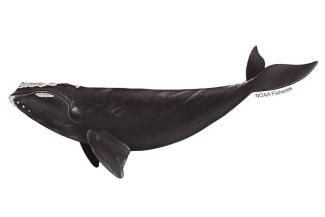
As with all marine mammals, NOAA Fisheries and the U.S. Fish and Wildlife Service are the managing agencies. Please refer to their websites for complete details.
Identification:
The North Atlantic right whale (Eubalaena glacialis) is one of the world’s most endangered large whale species. The North Atlantic right whale has a stocky black body with no dorsal fins, and their blow spouts are shaped like a “V”. Their tails are broad, deeply notched, and all black with a smooth trailing edge. Their bellies may be all black or have irregularly shaped white patches. Pectoral flippers are relatively short, broad, and paddle shaped. Their heads have knobby white patches of rough skin, called callosities, which appear white because of whale lice (cyamids) covering their otherwise black sin. Each right whale has a unique pattern of callosities that scientists use to identify individual whales, an invaluable tool in tracking population size and health.
Consortium’s photo-identification database for North Atlantic Right Whales
Residency time in Rhode Island:
The North Atlantic right whale migrates seasonally along the U.S. East Coast, moving between southeastern calving grounds (Georgia/Florida area) and feeding grounds in New England and Canadian waters. Waters south of Rhode Island, including Block Island and the continental shelf south of New England, are recognized as part of a major seasonal aggregation area for the species. NOAA and Massachusetts marine agencies identify “Southern New England” as one of the five principal seasonal-use regions for right whales. Sightings are most common offshore rather than directly along beaches. Areas south of Block Island and offshore shipping lanes can see right whale activity in winter, spring, and early migration periods.
Additional Materials:

As with all marine mammals, NOAA Fisheries and the U.S. Fish and Wildlife Service are the managing agencies. Please refer to their websites for complete details.
Identification:
Sei whale (Balaenoptera borealis) have a long, sleek body that is dark blueish gray to black in color and white or cream-colored underside. The body is often covered in oval-shaped scars (probably caused from cookie-cutter shark and lamprey bites) and sometimes has subtle “mottling,” or discolored spots or blotches. Sei whales have a tall, hooked dorsal fin located about two thirds of the way down their back. At the water’s surface, sei whales can be recognized by a columnar or bushy blow that is about 10 to 13 feet high. The dorsal fin usually appears at the same time as the blowhole when the animal surfaces to breathe.
Residency time in Rhode Island:
Sei whales are not considered permanent residents of Rhode Island waters, but they are recurring seasonal offshore visitors in the broader Southern New England region that includes waters south of Rhode Island. Sei whales occur seasonally in the western North Atlantic, moving north into feeding areas during spring and summer and shifting southward in colder months. Sei whales are strongly associated with offshore, deeper waters such as Georges Bank, the shelf edge, and waters south of New England rather than nearshore Rhode Island. Sei whales are most likely to be seen offshore of Block Island, toward the continental shelf, and Georges Bank system. Sei whales are best thought of as an uncommon to occasional offshore seasonal visitor.
NOAA notes that sei whales have unusually unpredictable movement patterns compared to other whales like humpbacks. Sei whales will sometimes appear in large numbers in one area and then not return for years or decades (This is unusual for large whales, who generally have a predictable distribution).
Additional Materials:

As with all marine mammals, NOAA Fisheries and the U.S. Fish and Wildlife Service are the managing agencies. Please refer to their websites for complete details.
Identification:
The sperm whale (Physeter macrocephalus) is the largest of the toothed whales and have one of the widest global distributions of any marine mammal species. Sperm whales are mostly dark gray, though some whales have white patches on the belly. They are the only living cetacean that has a single blowhole asymmetrically situated on the left side of the crown of the head. Their heads are extremely large, accounting for about one third of their total body length. The skin behind the head is often wrinkled with their lower jaw being narrow. Sperm whale flippers are paddle-shaped and small compared to the size of the body, and their flukes are triangular. They have small dorsal fins that are low, thick, and usually rounded.
Residency time in Rhode Island:
Sperm whales are not resident year-round in Rhode Island waters, but they do show recurring seasonal use of the offshore Southern New England region, especially south of Rhode Island near the continental shelf and canyon systems. Sperm whales will occur in Southern New England waters throughout the year, but their presence is strongly seasonal. NOAA researchers concluded that sperm whales “seasonally use inshore shallow waters off of Southern New England likely following squid prey. (Sperm whales were present mainly from May through August, with a secondary peak in October – November)
Most sightings of sperm whales near Rhode Island waters occur offshore in federal waters, especially off the south of Block Island, around Cox’s Ledge, near the continental shelf edge, and toward deep submarine canyon habitats.
Additional Materials:

As with all marine mammals, NOAA Fisheries and the U.S. Fish and Wildlife Service are the managing agencies. Please refer to their websites for complete details.
Identification:
The Atlantic white-sided dolphin (Lagenorhynchus acutus) is named after the distinctive yellowish-tan streaks on their sides. Atlantic white-sided dolphins are relatively small dolphins, reaching about 8 to 9 feet in length. Males are generally slightly larger than females. These dolphins have a robust streamlined body with a very small beak with a dark upper and white lower lip. They have a distinct prominent, relatively large, tall, falcate dorsal fin, located midway down the back. They have a dark grey cape with lighter gray sides and a white underside. There is also a bold white patch below a yellow-tan streak on the animal’s flank.
Residency time in Rhode Island:
Atlantic white-sided dolphins are not permanent year-round residents of Rhode Island coastal waters, but they are among the more regularly occurring offshore dolphins. Rhode Island’s Ocean SAMP marine mammal assessment lists them as present all seasons, though most abundant farther offshore than directly along the RI coast. Their preferred habitat is continental shelf and offshore temperate water rather than shallow nearshore bays. Abundance generally increases farther south during winter and spring as cold water masses shift in the western North Atlantic.
Peak occurrence of the Atlantic white-sided dolphin is generally spring, summer, and fall in offshore waters.
Additional Materials:
Reptiles
Rhode Island has five species of sea turtle that may visit the area at different times of year. Sea turtles are protected species, so make sure to keep your distance if you are lucky enough to see one. For more information on how to respond to an injured sea turtle, please see Protected Species Response.
All sea turtles are federally managed by NOAA Fisheries and the U.S. Fish and Wildlife Service. Please refer to their websites for complete details.

As with all sea turtles, NOAA Fisheries and the U.S. Fish and Wildlife Service are the managing agencies. Please refer to their websites for complete details.
Identification:
The green sea turtle (Chelonia mydas) is the largest hard-shelled sea turtle. They are unique among sea turtles in that they are primarily herbivores, although they may also eat sponges and other invertebrates and discarded fish when available. Despite being the largest of the hard-shelled sea turtles, they have a comparatively small head. An average adult is 3 to 4 feet long and they have dark brown-, grey-, or olive-colored shells with a much lighter, yellow to white underside. Their shells have five scutes running down the middle and four scutes on each side.
The green sea turtle gets its name from the color of their fat! (not their shells) The color of their fat was originally attributed to their diet; however, other sea turtles have greenish fat as well.
Residency time in Rhode Island:
Green sea turtles are not permanent residents of Rhode Island waters, but juvenile green turtles seasonally occupy southern New England coastal habitat for several months each year. Green sea turtles in Rhode Island are mostly juveniles using the region as a summer and early-fall developmental feeding habitat. They typically arrive as waters warm in late spring or early summer and remain until ocean temperatures decline in autumn. Green sea turtles can be seen through June through October, sometimes extending into November during warm years. As temperatures fall below 50 °F, green turtles become vulnerable to “cold stunning,” a hypothermia-like condition that can immobilize them.
Most sighting of green turtles in Rhode Island seem to occur in Block Island Sound, coastal ponds, Narragansett Bay entrances, Point Judith area, and nearshore eelgrass habitat. Juveniles are especially attracted to shallow vegetated habitats with algae and seagrass.
Additional Materials:
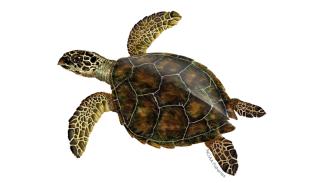
As with all sea turtles, NOAA Fisheries and the U.S. Fish and Wildlife Service are the managing agencies. Please refer to their websites for complete details.
Identification:
The hawksbill sea turtle (Eretmochelys imbricata) has a mottled shell consisting of an irregular combination of shades of amber, orange, red, yellow, black and brown. The shells typically have serrated edges, with overlapping scutes. Their head comes to a tapered point, and their lower jaw is V-shaped giving them a hawk-like appearance (hence the name). Hawksbill grow up to 2 to 3 feet in shell length. Hawksbills have four scales (two pairs) between their eyes and four scutes along the edge of each side of their carapace.
Residency time in Rhode Island:
Hawksbill sea turtles are not considered residents of Rhode Island and spotting of any would be incredibly rare. Hawksbill sea turtles are a highly tropical/subtropical species associated with coral reefs, rocky reef habitats, lagoons, and warm coastal waters. They are seldomly reported north of Florida. Any hawksbill occurrence near Rhode Island would be considered extremely rare, transient, and probably associated with unusual warm water transport or drifting juveniles.
If a hawksbill were encountered in Rhode Island waters, it would likely only remain briefly, occur during the warmest months (late summer to early fall), and face thermal stress risk as temperatures cool.
Additional Materials:

As with all sea turtles, NOAA Fisheries and the U.S. Fish and Wildlife Service are the managing agencies. Please refer to their websites for complete details.
Identification:
Kemp’s ridley sea turtle (Lepidochelys kempii) is the smallest sea turtle in the world. The species is named after Richard M. Kemp, a fisherman from Key West, Florida, who first submitted the species for identification in 1906. The Kemp’s ridley sea turtle has a triangular-shaped head with a slightly hooked beak. Hatchlings are darkly colored on both sides. Adults are generally a grayish – green color on top with a pale, yellowish bottom shell. The top shell (carapace) is often as wide as it is long. Each of the front flippers has one claw while the back flippers may have one or two.
Residency time in Rhode Island:
Kemp’s ridley sea turtles are seasonal visitors to southern New England. Most Kemp’s ridley sea turtles in Rhode Island and nearby New England water are juveniles. Their seasonal residency in southern New England generally lasts from late spring through autumn, with many individuals remaining about 3 – 5 months before attempting southward migration. Peak occurrence is usually from June through October, occasionally extending into November during warmer years. For Rhode Island waters, they are most likely to occur in shallow coastal waters, Block Island Sound, Narragansett Bay Approaches, and other nearshore sandy or muddy feeding habitats.
An important regional trend is that Kemp’s ridley sea turtles are now appearing in New England waters more frequently than historically, likely linked to warming northwest Atlantic waters.
Additional Materials:

As with all sea turtles, NOAA Fisheries and the U.S. Fish and Wildlife Service are the managing agencies. Please refer to their websites for complete details.
Identification:
The leatherback sea turtle (Dermochelys coriacea) is the largest turtle in the world. They are the only species of sea turtle that lack scales and a hard shell. The leatherback has primarily black, rubbery skin with pinkish-white coloring on its underside. Their shell (carapace) consists of small, interlocking dermal bones beneath the skin that overlie a supportive layer of connective tissue and fat and the deeper skeleton. Their carapace has seven ridges along its length and tapers to a blunt point. Their front flippers are proportionally longer than in other sea turtles and their back flippers are paddle shaped.
Residency time in Rhode Island:
Leatherback sea turtles are highly migratory, some swimming over 10,000 miles a year between nesting and foraging grounds. Leatherback sea turtles will seasonally migrate through Southern New England waters. Among sea turtles in Rhode Island, leatherbacks actually have one of the clearest recurring seasonal-use patterns. Leatherbacks routinely migrate into New England waters each year to feed on jellyfish. Leatherbacks are associated with offshore shelf waters south of Rhode Island, Block Island Sound, and the continental shelf edge where jellyfish concentrations develop. Leatherbacks are the sea turtle species most commonly reported by boaters in southern New England waters.
For the best chance at spotting a leatherback, they generally occur in spring through early autumn, with peak occurrence in summer, especially June through September.
Additional Materials:

As with all sea turtles, NOAA Fisheries and the U.S. Fish and Wildlife Service are the managing agencies. Please refer to their websites for complete details.
Identification:
The loggerhead sea turtle (Caretta caretta) is named for its large head, which supports powerful jaw muscles that enable them to feed on hard-shelled prey, such as whelks and conch. The top shell (carapace) is slightly heart-shaped and reddish brown in adults and sub adults, while the bottom shell (plastron) is generally a pale yellowish color. The neck and flippers are usually dull brown to reddish brown on top and medium to pale yellow on the sides and bottom.
Residency time in Rhode Island:
Loggerhead sea turtles are seasonal visitors to Rhode Island and Southern New England waters. Loggerheads are one of the more regular offshore seasonal species observed. Juvenile loggerheads migrate into Southern New England waters during warmer months to forage with their residency typically lasting from late spring through fall. Most loggerheads occur during May or June through October in Rhode Island waters. Loggerheads are known to move broadly between Rhode Island, Massachusetts, Long Island, and offshore while feeding in the area.
Most sightings of loggerheads in Rhode Island waters occur offshore south of Narragansett, around Block Island Sound, and along continental shelf waters where prey concentrations occur.
Additional Materials: